Cumulative GPA vs Semester GPA Explained
Notice that simply averaging the four semester GPAs gives 3.33 as well in this particular case, but that is a coincidence caused by the similar credit hour counts per semester.
Free GPA Calculator
Calculate your GPA instantly
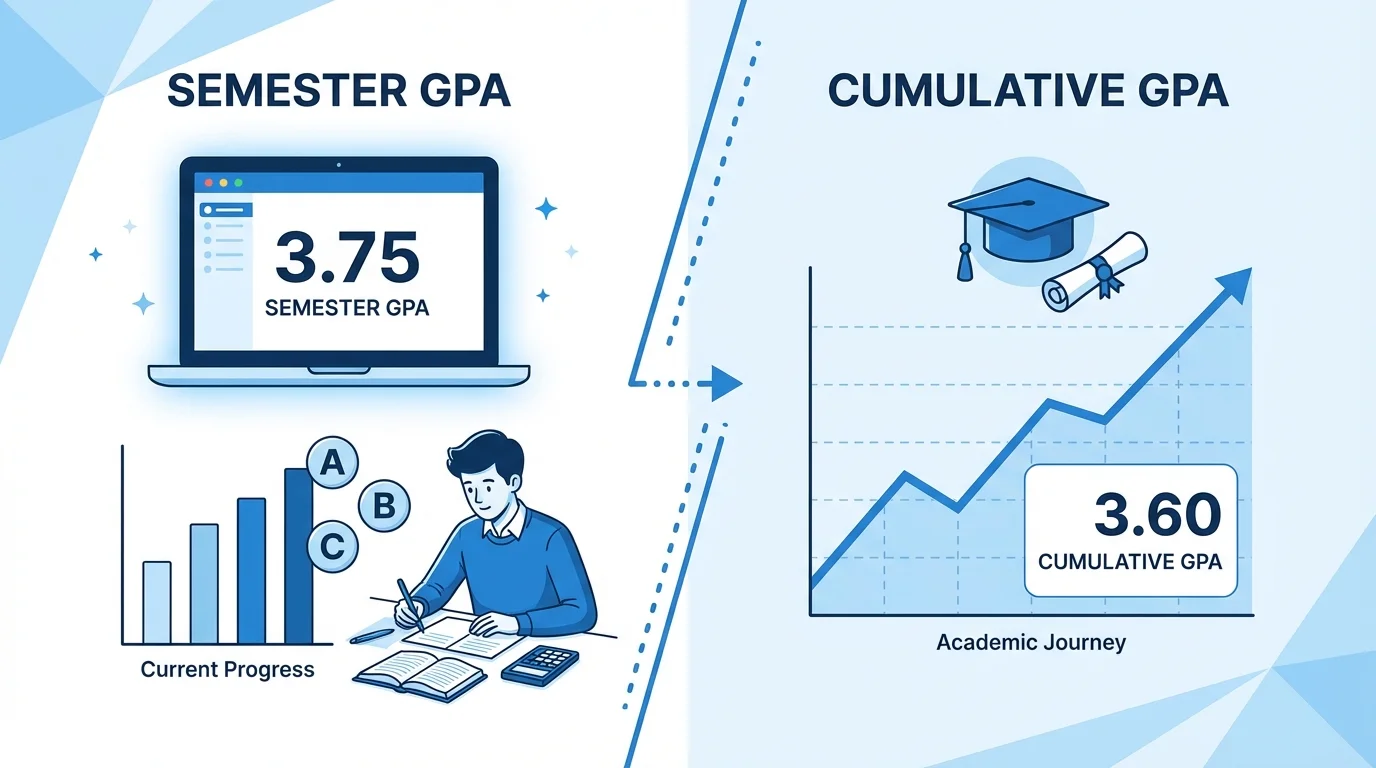
If you have ever looked at your academic transcript and noticed two different GPA numbers listed side by side, you probably wondered what the difference was. One is your semester GPA and the other is your cumulative GPA. They measure different things, they are used in different situations, and understanding how both work will give you a much clearer picture of where you stand academically.
This guide explains both in detail, shows you how each is calculated, and tells you when each one actually matters.
What Is Semester GPA?
Your semester GPA reflects your academic performance during a single term only. It is calculated using just the courses you completed in that one semester, and it starts fresh every time a new term begins.
Think of it as your report card for one specific chapter of your academic story. A strong semester GPA tells you that you performed well during that period. A weak one tells you something went wrong that term and gives you a signal to course correct.
Semester GPA is commonly used for Dean's List recognition, which most schools award based on a student hitting 3.5 or above in a single term. It is also used for academic probation warnings, since many institutions place students on probation when their semester GPA drops below 2.0 in any given term. Scholarship renewals that require a minimum per semester performance also rely on semester GPA, as does program eligibility for students who must maintain a certain grade average within their major courses each term.
What Is Cumulative GPA?
Your cumulative GPA is the running average of every course you have completed at your institution from day one to the present. Every grade from every semester is factored in, weighted by credit hours, and averaged into one number.
This is the number that follows you everywhere. It is what appears most prominently on your official transcript. It is what colleges, graduate schools, and employers ask about when they say "what is your GPA?" It builds up slowly over time, and because of that, it is harder to move dramatically in either direction.
Cumulative GPA is the primary metric used for college transfer applications, graduate and professional school admissions, graduation honors like Cum Laude, Magna Cum Laude, and Summa Cum Laude, most employer requests for GPA on job applications, and maintaining your overall academic standing at your institution.
The Key Differences at a Glance
| Feature | Semester GPA | Cumulative GPA |
|---|---|---|
| Time period covered | One semester only | All semesters combined |
| Resets each term | Yes | No |
| Appears on transcript | Yes | Yes, more prominently |
| Used for job applications | Rarely | Almost always |
| Changes quickly | Yes | Very slowly |
| Used for Dean's List | Yes | No |
| Used for graduation honors | No | Yes |
How to Calculate Semester GPA
Semester GPA uses the same formula as any standard GPA calculation. You convert each letter grade to grade points, multiply by credit hours, add everything together, and divide by total credit hours.
Here is a worked example for a spring semester:
| Course | Grade | Grade Points | Credit Hours | Quality Points |
|---|---|---|---|---|
| English Literature | A | 4.0 | 3 | 12.0 |
| Calculus II | B+ | 3.3 | 4 | 13.2 |
| Sociology | A | 3.7 | 3 | 11.1 |
| Chemistry Lab | B | 3.0 | 4 | 12.0 |
| Spanish II | B+ | 3.3 | 3 | 9.9 |
| Total | 17 | 58.2 |
Semester GPA = 58.2 divided by 17 = 3.42
This student earned a 3.42 semester GPA for the spring term.
How to Calculate Cumulative GPA
Cumulative GPA is not found by simply averaging your semester GPAs together. That is one of the most common mistakes students make, and it almost always produces an inaccurate result.
The correct method is to combine all quality points from every semester and divide by all credit hours attempted across every semester.
Formula: Total Quality Points from All Semesters divided by Total Credit Hours from All Semesters = Cumulative GPA
Here is why the simple average fails:
If you took 6 credit hours one semester with a 4.0 GPA and 18 credit hours another semester with a 2.0 GPA, averaging 4.0 and 2.0 gives you 3.0. But that is wrong. The heavier semester carries three times more weight, so the real cumulative GPA should be much closer to 2.0 than to 4.0.
Let us do it correctly:
| Semester | GPA | Credit Hours | Quality Points |
|---|---|---|---|
| Fall Year 1 | 3.20 | 15 | 48.0 |
| Spring Year 1 | 3.42 | 17 | 58.1 |
| Fall Year 2 | 3.60 | 15 | 54.0 |
| Spring Year 2 | 3.10 | 16 | 49.6 |
| Total | 63 | 209.7 |
Cumulative GPA = 209.7 divided by 63 = 3.33
Notice that simply averaging the four semester GPAs gives 3.33 as well in this particular case, but that is a coincidence caused by the similar credit hour counts per semester. When semesters have very different credit loads, the correct method will always produce a different and more accurate number.
How a Bad Semester Affects Your Cumulative GPA
One of the most anxiety producing moments for students is having a terrible semester and wondering how badly it will damage their overall GPA. The honest answer is: it depends on how many credits you have already completed.
Here is a concrete example:
You have finished 45 credit hours with a 3.50 cumulative GPA. Then you have a rough semester: 15 credits with a 2.20 GPA.
| Period | GPA | Credits | Quality Points |
|---|---|---|---|
| Before bad semester | 3.50 | 45 | 157.5 |
| Bad semester | 2.20 | 15 | 33.0 |
| After bad semester | 3.17 | 60 | 190.5 |
Your cumulative GPA drops from 3.50 to 3.17. That is painful, but not catastrophic. And because you now have 60 credit hours total, recovering will take consistent strong performance over several semesters.
If you are early in your academic career with only 15 credit hours completed, one bad semester has a much larger impact. This is why getting off to a strong start matters so much.
How Long Does It Take to Raise a Cumulative GPA?
This is a question every student who has had a rough patch wants answered. The math is clear but sometimes discouraging.
If you have 30 credit hours completed with a 2.5 GPA and want to reach 3.0, here is what it looks like:
You would need to earn approximately 150 additional quality points over future semesters. If you average 15 credit hours per semester with a 3.5 GPA, that generates 52.5 quality points per term. At that rate, it would take roughly 3 semesters of very strong work to pull your cumulative GPA up to around 3.0.
The earlier you start pushing for better grades, the faster your cumulative GPA recovers. Waiting until junior or senior year to turn things around leaves much less runway to improve the overall number.
Which GPA Should You Pay Attention To?
The simple answer is: both, but for different reasons.
Watch your semester GPA as a real time feedback signal. It tells you how you are performing right now, in the courses you are currently taking. If it drops significantly from one semester to the next, that is your cue to investigate why and make adjustments before the damage compounds into your cumulative GPA.
Watch your cumulative GPA as your long term academic record. This is what external parties see when they evaluate you. It represents the full picture of your academic career and is the number you want to protect and grow over time.
Final Thoughts
Semester GPA and cumulative GPA each tell a different part of your academic story. Your semester GPA is the short term feedback you need to stay on course each term. Your cumulative GPA is the long term record that defines your academic standing in the eyes of the outside world. Understanding both and knowing how each is calculated puts you in a position to manage your academic performance with intention rather than just reacting to grades as they come. Use our cumulative GPA calculator to see exactly where you stand and what it will take to get where you want to go.
Frequently Asked Questions
If I retake a course, which grade affects my cumulative GPA?
Can my semester GPA be much higher than my cumulative GPA?
Does my semester GPA affect my financial aid?
What GPA qualifies for graduation honors?
What is scholastic probation?
Written by
Adnan Ajmal
Software Developer
Adnan built GPA Calculator to give students a free, transparent tool for tracking their academic standing. All formulas follow the standard weighted average method used by US university registrars. Learn more about this site.
Related Articles

PhD Program GPA Requirements: What Admissions Committees Actually Look For
PhD admissions committees evaluate GPA through three lenses: trajectory (did grades improve over time?), subject alignment (were strong grades earned in relevant courses?), and institutional context (what does this GPA represent at this institution?). The minimum stated threshold is 3.0 at most programmes; the competitive threshold for admission at programmes of significant quality is 3.5 or above.

Academic Dismissal and GPA: Your Options for Readmission
Academic dismissal is the formal separation of a student from their institution after sustained failure to meet minimum GPA standards, typically a 2.0 cumulative average. Most institutions provide a structured readmission pathway through a formal appeal process, a required separation period of one academic year, and specific academic conditions attached to reinstatement.

Grade Forgiveness Policies: Which Colleges Offer Second Chances
Grade forgiveness policies, also called academic renewal, fresh start, or grade replacement depending on the institution, allow students to reduce or eliminate the GPA impact of previously earned failing grades. The original grades remain on the transcript in nearly all cases but are excluded from the cumulative GPA calculation. Graduate and professional school applications, including AMCAS and LSAC, typically include all attempted courses regardless of institutional forgiveness.

AP Exam Scores vs AP Class Grades: Which Matters More for GPA
AP class grades enter the high school weighted GPA calculation directly. AP exam scores do not. An A in AP Chemistry earns 5.0 weighted quality points regardless of what score the student earns in May. However, colleges use AP exam scores as an external benchmark to evaluate whether class grades reflect genuine mastery, and in the current test-optional environment, this evaluative role has grown.