How Many A's It Takes to Raise Your GPA by 0.1
The number of A grades needed to raise a GPA by 0.1 depends on total credit hours already completed. A student with 30 credits needs fewer A-grade courses than one with 90 credits earning the same target increase.
Free GPA Calculator
Calculate your GPA instantly
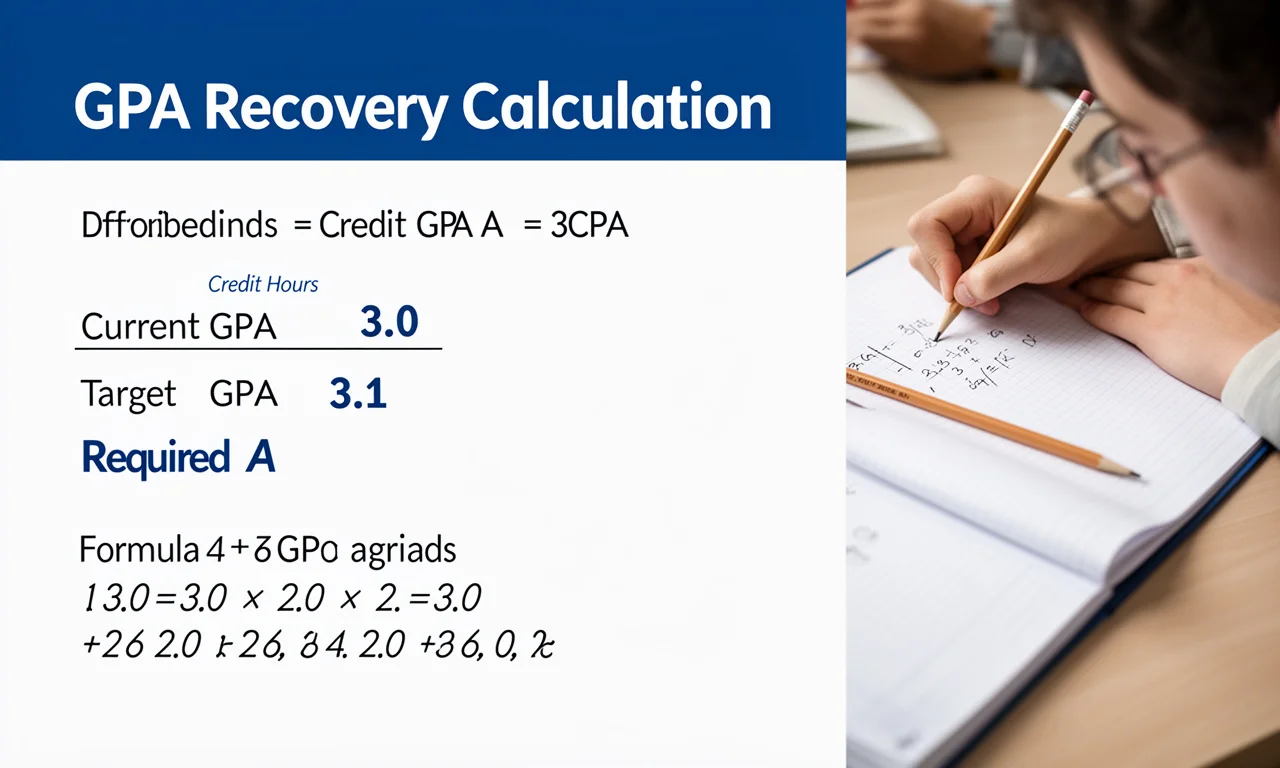
Raising a Grade Point Average (GPA) by 0.1 requires earning A grades across a specific number of credit hours — and that number grows larger as total completed credits accumulate. A student with 30 completed credits needs approximately 7 to 10 additional all-A credits to gain 0.1 GPA points. A student with 90 completed credits needs 20 to 30 additional all-A credits to achieve the same 0.1 gain. The formula that produces these numbers is the credit-weighted quality points calculation.
How do you calculate how many A's are needed to raise GPA by 0.1?
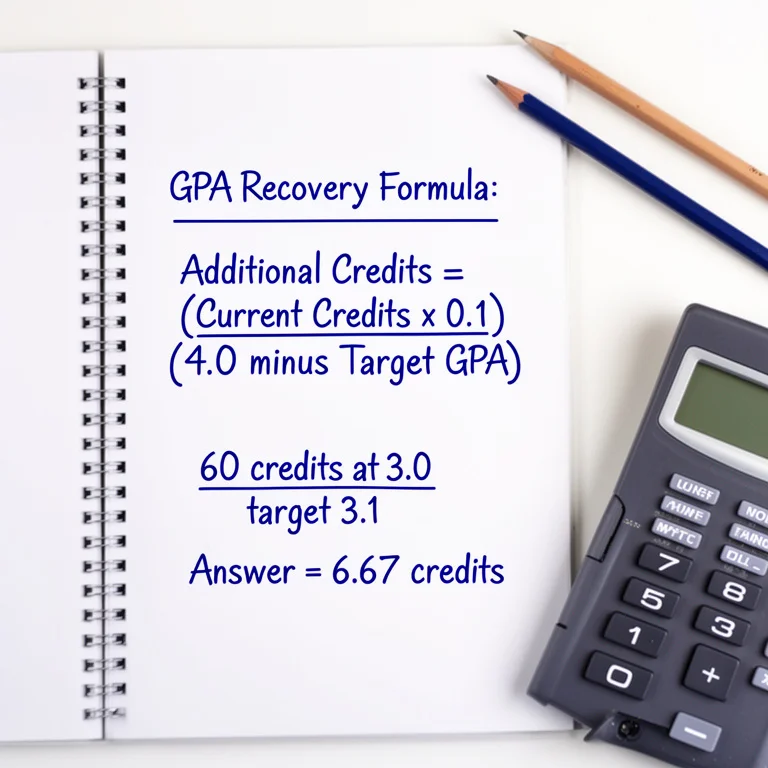
Use this formula: Additional Credits Needed = (Current Credits × 0.1) ÷ (4.0 − Target GPA). Plug in the current credit total and target GPA to get the minimum all-A credits required. Round up to the nearest 3-credit course increment.
The formula derives from the quality points equation. Every course contributes quality points equal to grade points multiplied by credit hours. Earning a 4.0 in a 3-credit course adds 12 quality points to the numerator while adding 3 to the denominator. The net effect on GPA depends entirely on how large the denominator — total completed credits — already is.
Full formula:
Additional Credits = (Current Credits × (Target GPA − Current GPA)) ÷ (4.0 − Target GPA)
Example: Current GPA 3.0 on 60 credits, target 3.1
Additional Credits = (60 × 0.1) ÷ (4.0 − 3.1) = 6 ÷ 0.9 = 6.67 credits
Rounded up to 9 credits — three 3-credit courses all earned at A — raises the cumulative GPA from 3.0 to approximately 3.08. Reaching exactly 3.1 requires 12 credits (four 3-credit A grades).
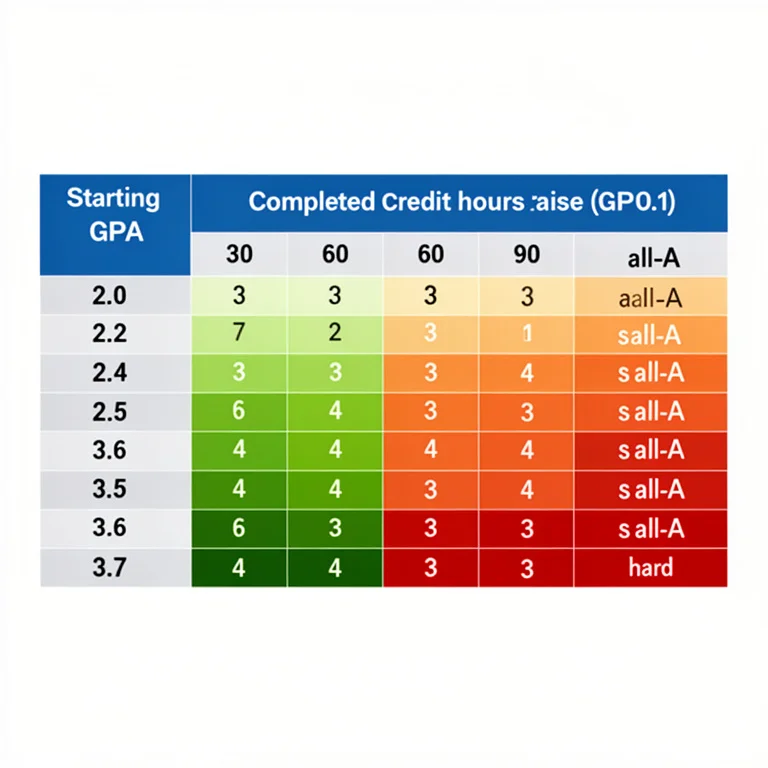
How many A's does it take to raise GPA by 0.1 at different starting points?
The number of all-A credits needed to raise GPA by 0.1 ranges from 4 credits at a 2.0 GPA with 30 completed credits, to 34 credits at a 3.5 GPA with 120 completed credits. The higher the starting GPA and the more credits completed, the harder each 0.1 gain becomes.
The table below uses the formula above to calculate required all-A credits for the most common starting scenarios:
| Starting GPA | Credits Completed | All-A Credits Needed for +0.1 |
|---|---|---|
| 2.0 | 30 | 3 credits (~1 course) |
| 2.5 | 30 | 4 credits (~1 to 2 courses) |
| 3.0 | 30 | 7 credits (~2 to 3 courses) |
| 3.0 | 60 | 14 credits (~4 to 5 courses) |
| 3.0 | 90 | 21 credits (~7 courses) |
| 3.2 | 60 | 17 credits (~5 to 6 courses) |
| 3.5 | 60 | 12 credits (~4 courses) |
| 3.5 | 90 | 18 credits (~6 courses) |
| 3.5 | 120 | 34 credits (~11 courses) |
| 3.7 | 60 | 20 credits (~6 to 7 courses) |
These numbers assume all additional courses are completed at a pure 4.0 (A grade). A mix of A and B grades reduces the GPA gain per credit and increases the number of courses needed.
Why does GPA become harder to raise as credit hours accumulate?
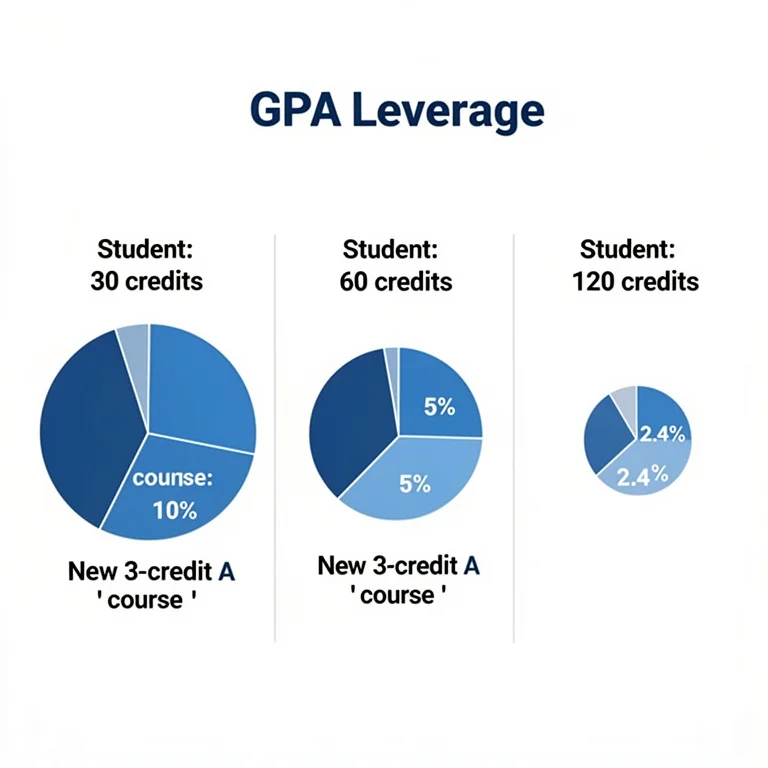
GPA becomes harder to raise because each new course adds credits to a denominator that grows with every semester. A 3-credit A grade has 10 times less impact on a student with 120 credits than on a student with 12 credits, because the quality point gain is divided across a much larger base.
The credit-hour denominator functions as an anchor. At 30 completed credits, a single 3-credit A course represents 10% of the total credit pool and shifts GPA meaningfully. At 120 completed credits, the same A course represents only 2.4% of the pool. Three distinct scenarios illustrate this:
- A student with 12 credits (first semester) who earns all A's in 15 new credits can raise a 2.5 GPA to approximately 3.1 — a gain of 0.6 in one semester.
- A student with 90 credits at 3.0 who earns all A's in 15 new credits moves the cumulative GPA to approximately 3.05 — a gain of 0.05 in one semester.
- A student with 120 credits at 3.5 who earns all A's in a final 15-credit semester raises the cumulative GPA to approximately 3.56 — a gain of 0.06.
Does course credit value affect how many A's are needed?
Yes. A 4-credit course at A grade produces 16 quality points, while a 3-credit course at A grade produces 12. Taking A grades in higher-credit courses — laboratory sciences, engineering sequences, and capstone projects — raises GPA faster per course than taking A grades in 1-credit electives.
Three course credit values and their GPA impact at a 3.0 GPA on 60 credits:
- 1-credit A course: adds 4.0 quality points and raises 3.0 GPA by approximately 0.01
- 3-credit A course: adds 12.0 quality points and raises 3.0 GPA by approximately 0.029
- 4-credit A course: adds 16.0 quality points and raises 3.0 GPA by approximately 0.038
Students selecting course loads for GPA recovery purposes gain the most ground by earning A grades in high-credit courses first. A single A in a 4-credit biology lab course moves GPA further than four A grades in four 1-credit electives, because the denominator adds only 4 credits in both cases while the numerator gains 16 quality points either way.
What mix of grades is needed if not all courses can be A's?
A mix of A and B grades still raises GPA, but at a slower rate than all-A performance. Each B grade (3.0) in a 3-credit course adds 9 quality points instead of 12, reducing the net GPA gain per credit from 0.029 to 0.015 at a 3.0 baseline with 60 credits.
The impact of mixed grades on a 3.0 GPA with 60 completed credits adding 15 new credits:
| Grade Mix (15 credits) | New Cumulative GPA | Net Gain |
|---|---|---|
| All A (4.0) | 3.11 | +0.11 |
| 3 A's and 2 B's (5 courses) | 3.07 | +0.07 |
| 2 A's and 3 B's (5 courses) | 3.05 | +0.05 |
| All B (3.0) | 3.00 | +0.00 |
| 1 C among 4 A's and 1 B | 3.07 | +0.07 |
A student targeting a 0.1 GPA gain with a realistic mix of A and B grades should expect to need 20 to 30 credits rather than the 14 the pure-A formula produces. The free GPA calculator at gpacalculator.uk accepts grade-by-grade input and computes the exact cumulative GPA after each course is entered. For students recovering from a difficult semester, the academic recovery guide covers the semester-by-semester planning process. Students working toward a GPA target for scholarship eligibility can review the GPA requirements for full ride scholarships to identify which thresholds matter most. All GPA planning articles are available in the resources section at gpacalculator.uk/resources.
Frequently Asked Questions
How many A's do I need to raise my GPA by 0.1?
Can one semester of straight A's raise your GPA by 0.1?
Does a 4-credit course raise GPA more than a 3-credit course?
What GPA can you realistically raise in one semester?
Does a B grade help raise GPA?
Written by
Adnan Ajmal
Software Developer
Adnan built GPA Calculator to give students a free, transparent tool for tracking their academic standing. All formulas follow the standard weighted average method used by US university registrars. Learn more about this site.
Related Articles

Summer School GPA: Does It Help or Hurt Your Cumulative Average
Summer school can raise, hold flat, or lower a cumulative GPA depending on where the course is taken and what grade is earned. A summer course at the home institution enters the GPA formula directly. A summer course at a community college or another institution typically contributes credit hours but not the grade, leaving the cumulative GPA unchanged regardless of performance.

Incomplete Grades and GPA: How I Grades Affect Your Academic Standing
An incomplete grade (I) is excluded from the GPA calculation while it remains active at most institutions, because it carries no grade point value. The consequential question is what the I converts to when the resolution deadline passes: at most institutions, an unresolved incomplete automatically becomes an F, entering GPA at 0.0 quality points per credit hour and producing the same damage as a failed course.

Failing a Class: How One F Affects Your GPA and What to Do Next
Failing a class earns 0.0 quality points per credit hour and adds those credits to the GPA denominator without raising the numerator. The exact impact depends on how many credits were completed before the failure: the same 3-credit F drops a 3.2 GPA by 0.53 points at 15 completed credits but only 0.20 points at 45 completed credits.

Senior Year College GPA: Finishing Strong for Employers and Grad School
Senior year college GPA is the final number on a permanent academic record that appears in employer background checks, graduate school transcript requests, and professional credential verifications. According to NACE's 2024 Job Outlook Report, 38.3% of employers screen candidates by GPA, making the four-year cumulative average that includes senior year directly consequential in the first years after graduation.