Pass/Fail Classes and GPA: What Actually Changes
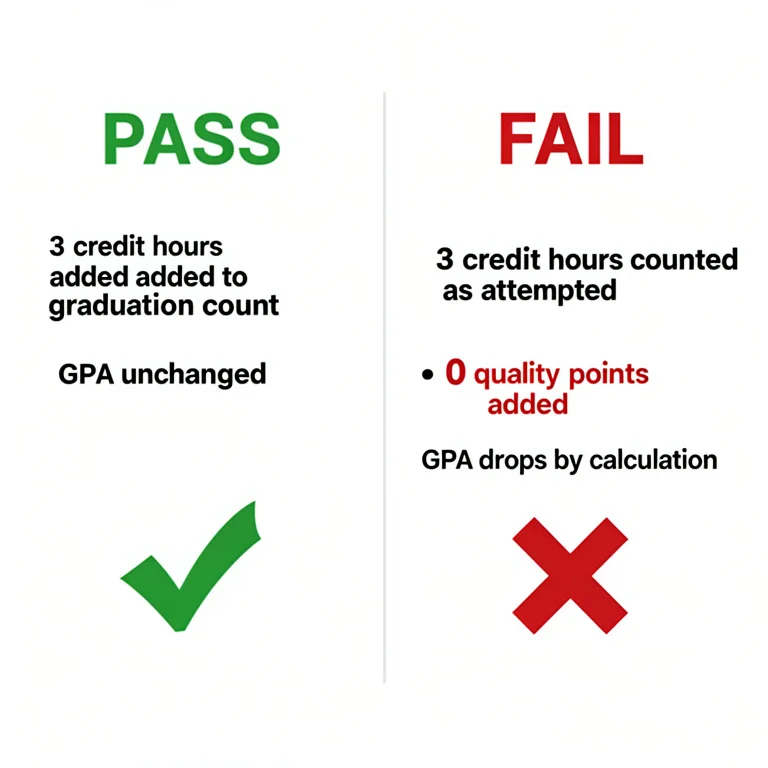
A passing grade in a pass/fail class does not affect GPA. A failing grade does — it adds 0.0 quality points while counting the credit hours as attempted, lowering the cumulative GPA. The two outcomes are not symmetrical.
Free GPA Calculator
Calculate your GPA instantly
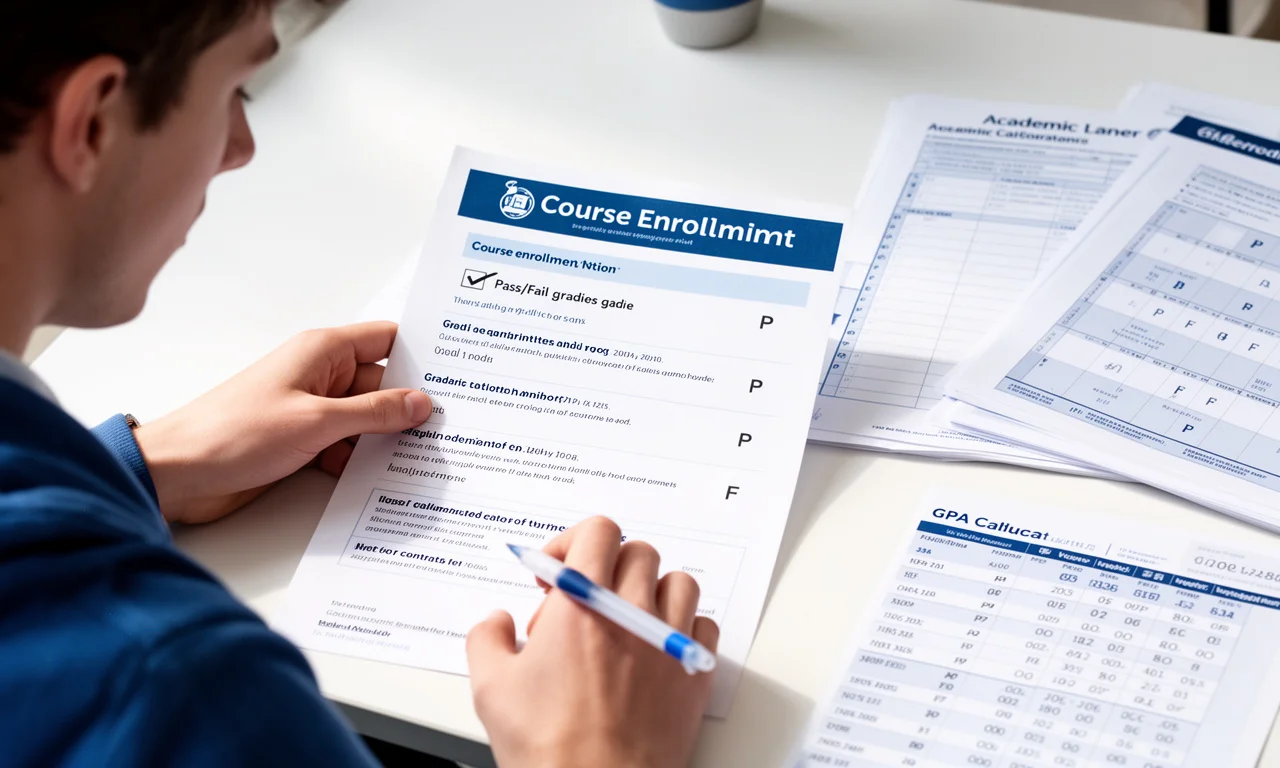
Pass/fail grading is a system in which a course is recorded on a transcript as either P (pass) or F (fail) rather than a letter grade. A passing grade in a pass/fail course adds credit hours toward graduation but contributes zero quality points to the Grade Point Average (GPA) calculation, leaving the GPA unchanged. A failing grade in a pass/fail course contributes 0.0 quality points while still counting the credit hours as attempted, which lowers cumulative GPA. The two outcomes are not symmetrical.
Does a pass in a pass/fail class affect your GPA?
A passing grade in a pass/fail class does not affect GPA. The course credits count toward graduation requirements, but no grade point value enters the quality points calculation. The cumulative GPA remains exactly the same as before the course was attempted.
Most institutions apply this rule consistently across undergraduate pass/fail courses, satisfactory/unsatisfactory (S/U) courses, and credit/no-credit (CR/NC) courses — all three naming conventions describe the same grading structure. A student holding a 3.4 GPA who completes a 3-credit pass/fail course and earns a P still holds exactly a 3.4 GPA after the course ends. The 3 credits count in the degree audit but not in the GPA denominator.
Does a fail in a pass/fail class affect your GPA?
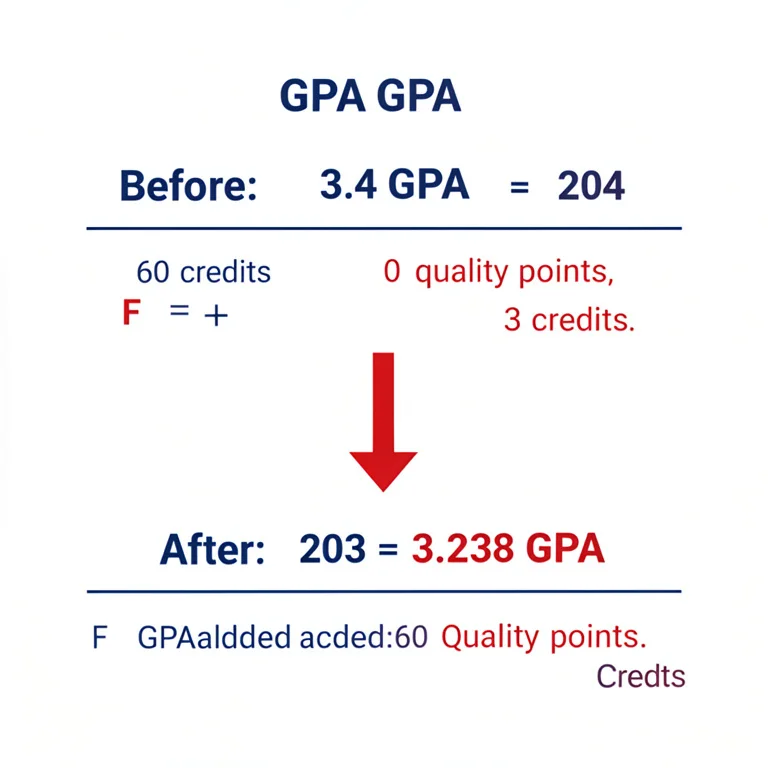
A failing grade in a pass/fail class lowers cumulative GPA. An F in a 3-credit pass/fail course adds 0.0 quality points and 3 credit hours to the denominator. A student with a 3.4 GPA on 60 credits who fails a 3-credit pass/fail course drops to approximately 3.24 GPA.
The GPA calculation after a pass/fail F:
- Before: 3.4 × 60 = 204 quality points, 60 credit hours
- F adds: 0.0 quality points, 3 credit hours
- After: 204 ÷ 63 = 3.238 GPA
The student loses 0.16 GPA points from a single failed pass/fail course. The loss is larger than most students expect because the denominator grows by 3 while the numerator gains nothing. Three course types where a pass/fail F carries the highest GPA damage: 4-credit laboratory science courses, 4-credit engineering practicum courses, and 3-credit capstone seminars in professional programs.
What is a withdrawal-fail (WF) grade and how does it affect GPA?
A withdrawal-fail (WF) is a grade assigned when a student stops attending a course after the official withdrawal deadline without completing the drop process. Many institutions count a WF as an F in the GPA calculation, adding 0.0 quality points while counting the credit hours as attempted.
WF policy varies by institution. At schools including the University of Georgia, Georgia Tech, and several California State University campuses, a WF grade carries the same GPA weight as an academic F. A student who stops attending a 3-credit course after week 10 at a WF-counting institution absorbs the same GPA penalty as failing the course outright.
Three pass/fail grading designations and their GPA treatment:
- P (Pass): no GPA impact; credits count for graduation
- F (Fail): 0.0 quality points; credits count as attempted; GPA drops
- WF (Withdrawal-Fail): treated as F at most institutions; 0.0 quality points; credits attempted
Students should verify their institution's specific WF policy in the academic catalog before withdrawing from any course past the standard drop deadline.
When does using pass/fail grading make sense for GPA strategy?
Pass/fail grading makes sense for courses outside a student's major where earning an A is unlikely and the grade would pull the cumulative GPA below the student's target. A student with a 3.6 GPA who projects a C in a 3-credit elective loses 0.076 GPA points from that C — converting to pass/fail protects the 3.6.
The GPA protection calculation: a C (2.0) in a 3-credit course adds 6.0 quality points. On a 60-credit 3.6 GPA base, the new cumulative becomes (216 + 6) ÷ 63 = 3.524 — a drop of 0.076. Converting the course to pass/fail and earning a P keeps the GPA at 3.6 exactly.

Three situations where pass/fail election is a sound GPA decision:
- Elective courses outside the student's field of study where subject matter is genuinely unfamiliar, such as foreign language electives, advanced fine arts, or upper-division sciences outside the major
- Courses taken during a semester with an unusually heavy course load, a family emergency, or a documented health disruption where performance is at risk across the board
- Physical education, first-year experience, and orientation seminars at institutions that allow P/F election on these course types and where letter grades would otherwise be recorded
What are the limits and risks of taking classes pass/fail?
Most universities cap pass/fail course elections at 12 to 16 total credits over a student's full academic career. Graduate schools and medical schools frequently exclude pass/fail courses when calculating GPA, requiring recalculation using only letter-graded courses.
Three institutional limits on pass/fail elections that students encounter:
- Required major courses cannot be taken pass/fail at most institutions. A biology major cannot take Genetics on a pass/fail basis if Genetics appears on the major's required course list.
- Minimum letter grade requirements for programs — nursing programs requiring C or above in all core courses, and engineering programs requiring C or above in math prerequisites — cannot be satisfied by a P grade, since a P provides no grade evidence of meeting the threshold.
- Graduate school applications, including law school (LSAC calculation), medical school (AMCAS calculation), and MBA programs, use only letter-graded courses in their GPA calculations. A transcript heavy with P grades reduces the sample size used for graduate GPA review and may raise concerns about grade transparency.
Students tracking the GPA impact of a potential pass/fail election can model the exact outcome using the free GPA calculator at gpacalculator.uk — enter the course at a projected C and then at A to see the GPA difference before deciding. For students managing GPA after a difficult semester that included a failing grade, the academic recovery guide covers the credit-weighted recovery plan. Students calculating how many A grades are needed to offset a failed course can use the formula in the guide on raising GPA by 0.1. All GPA planning resources are available in the resources section at gpacalculator.uk/resources.
Frequently Asked Questions
Does pass/fail affect GPA?
Does a pass/fail class show up on a transcript?
Can you fail a pass/fail class?
Do medical schools accept pass/fail grades?
When should you take a class pass/fail?
Written by
Adnan Ajmal
Software Developer
Adnan built GPA Calculator to give students a free, transparent tool for tracking their academic standing. All formulas follow the standard weighted average method used by US university registrars. Learn more about this site.
Related Articles

PhD Program GPA Requirements: What Admissions Committees Actually Look For
PhD admissions committees evaluate GPA through three lenses: trajectory (did grades improve over time?), subject alignment (were strong grades earned in relevant courses?), and institutional context (what does this GPA represent at this institution?). The minimum stated threshold is 3.0 at most programmes; the competitive threshold for admission at programmes of significant quality is 3.5 or above.

Academic Dismissal and GPA: Your Options for Readmission
Academic dismissal is the formal separation of a student from their institution after sustained failure to meet minimum GPA standards, typically a 2.0 cumulative average. Most institutions provide a structured readmission pathway through a formal appeal process, a required separation period of one academic year, and specific academic conditions attached to reinstatement.

Grade Forgiveness Policies: Which Colleges Offer Second Chances
Grade forgiveness policies, also called academic renewal, fresh start, or grade replacement depending on the institution, allow students to reduce or eliminate the GPA impact of previously earned failing grades. The original grades remain on the transcript in nearly all cases but are excluded from the cumulative GPA calculation. Graduate and professional school applications, including AMCAS and LSAC, typically include all attempted courses regardless of institutional forgiveness.

AP Exam Scores vs AP Class Grades: Which Matters More for GPA
AP class grades enter the high school weighted GPA calculation directly. AP exam scores do not. An A in AP Chemistry earns 5.0 weighted quality points regardless of what score the student earns in May. However, colleges use AP exam scores as an external benchmark to evaluate whether class grades reflect genuine mastery, and in the current test-optional environment, this evaluative role has grown.