Raising a 2.5 GPA to 3.0: The Exact Math and a Semester Plan
Raising a GPA from 2.5 to 3.0 requires 30 all-A credits at 30 completed credits, or up to 75 all-A credits at 90 completed credits. The exact number depends on how many credit hours have already been attempted.
Free GPA Calculator
Calculate your GPA instantly
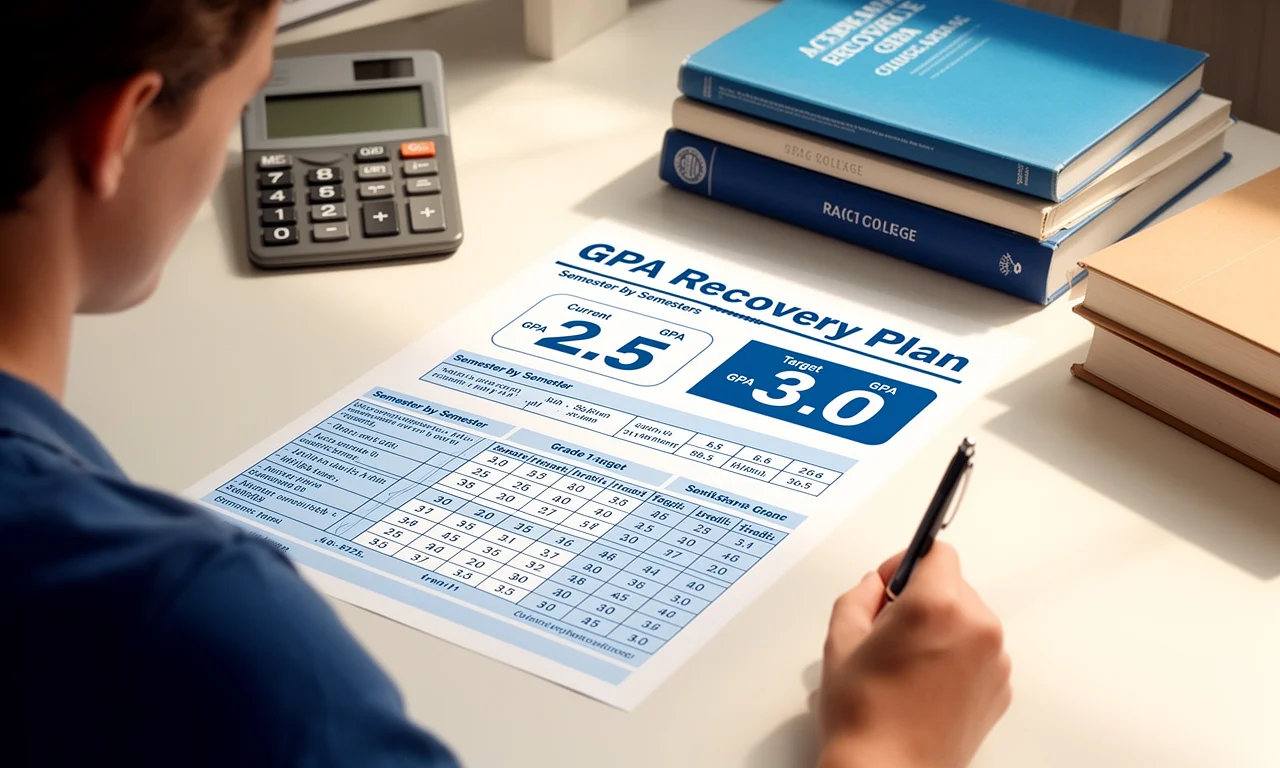
Raising a Grade Point Average (GPA) from 2.5 to 3.0 requires earning enough quality points above the 3.0 threshold to pull the cumulative average up by 0.5 grade points. The number of credits needed to accomplish that shift depends entirely on how many credit hours a student has already completed. A student with 30 completed credits needs approximately 30 additional all-A credits to reach 3.0. A student with 90 completed credits needs approximately 90 additional all-A credits to reach the same target — a realistic multi-year plan rather than a single semester goal.
Is it possible to raise a 2.5 GPA to 3.0?
Raising a 2.5 GPA to 3.0 is possible at any credit total, but the timeline ranges from one semester for students early in their academic career to two or more years for students who have accumulated 60 or more credits. The exact credit requirement grows proportionally with each semester already completed.
The credit-weighted formula for calculating required future GPA:
Required Semester GPA = (Target GPA × Total Future Credits − Current GPA × Current Credits) ÷ Planned Credits
Example: Student with 2.5 GPA on 60 credits, planning 15 credits next semester, target 3.0
Required GPA = (3.0 × 75 − 2.5 × 60) ÷ 15 = (225 − 150) ÷ 15 = 5.0
A required GPA of 5.0 exceeds the 4.0 maximum on the unweighted scale, which means a student with 60 completed credits cannot reach 3.0 in a single 15-credit semester regardless of grades. The maximum GPA achievable with straight A's across 15 new credits is (2.5 × 60 + 4.0 × 15) ÷ 75 = 2.80. Reaching 3.0 from that point requires further semesters of strong performance.
How many credits does it take to raise a 2.5 GPA to 3.0?
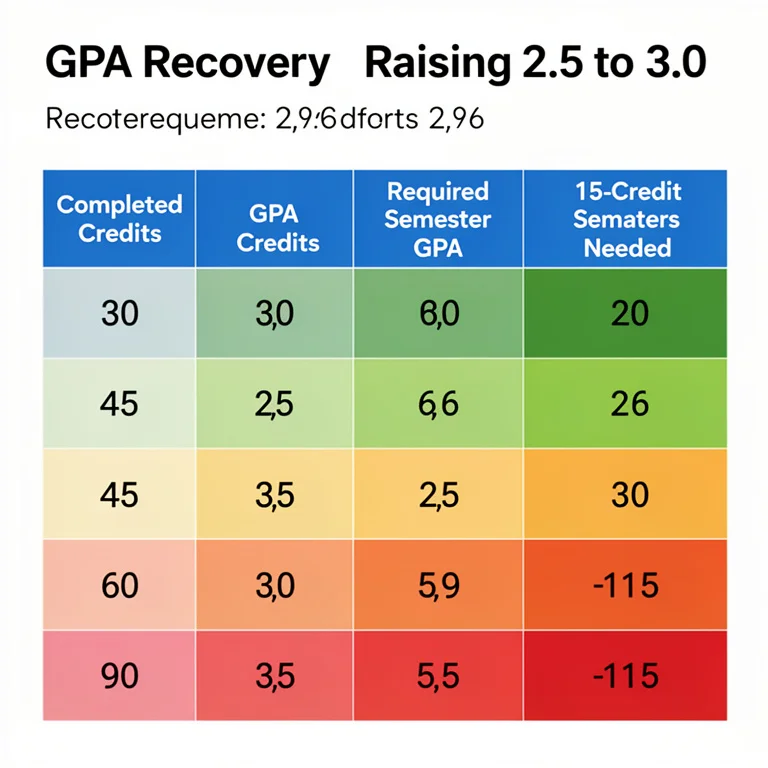
The number of additional credits required to move from 2.5 to 3.0 equals the current credit total when all future courses are earned at a 4.0 grade average. A student with 60 completed credits needs 60 additional credits of straight A performance to reach 3.0.
The derivation: Setting up the quality points equation where Current Credits × 2.5 + Additional Credits × 4.0 = (Current Credits + Additional Credits) × 3.0 and solving for Additional Credits:
Additional Credits = Current Credits × (3.0 − 2.5) ÷ (4.0 − 3.0) = Current Credits × 0.5 ÷ 1.0 = Current Credits × 0.5
Credits required at a 4.0 average by starting credit total:
| Completed Credits | All-A Credits Needed | Semesters at 15 Credits |
|---|---|---|
| 30 | 15 credits | 1 semester |
| 45 | 22 credits | 2 semesters |
| 60 | 30 credits | 2 semesters |
| 75 | 38 credits | 3 semesters |
| 90 | 45 credits | 3 semesters |
| 120 | 60 credits | 4 semesters |
These figures assume all future grades are A (4.0). A realistic grade mix of A's and B's increases the required credits significantly — at a 3.5 future average instead of 4.0, a student with 60 credits needs 60 additional credits rather than 30, which doubles the timeline.
What semester GPA is needed to raise 2.5 to 3.0 over multiple semesters?
A student with 60 completed credits at 2.5 GPA needs a consistent semester GPA of 3.5 or above across 4 to 5 consecutive 15-credit semesters to reach a cumulative 3.0. No single semester can accomplish the shift from that credit base.
The semester-by-semester trajectory at a sustained 3.5 average starting from 2.5 GPA on 60 credits:
| Semester | New Credits | Semester GPA | Cumulative GPA |
|---|---|---|---|
| Start | — | — | 2.50 |
| Semester 1 | 15 (75 total) | 3.5 | 2.61 |
| Semester 2 | 15 (90 total) | 3.5 | 2.69 |
| Semester 3 | 15 (105 total) | 3.5 | 2.76 |
| Semester 4 | 15 (120 total) | 3.5 | 2.81 |
| Semester 5 | 15 (135 total) | 3.5 | 2.86 |
| Semester 6 | 15 (150 total) | 3.5 | 2.90 |
A sustained 3.5 semester average does not reach 3.0 cumulative within a standard 4-year degree when starting at 60 completed credits and 2.5. Reaching 3.0 from that base requires a semester average of 3.8 to 4.0 across the remaining credits.

Does retaking courses help raise a 2.5 GPA to 3.0?
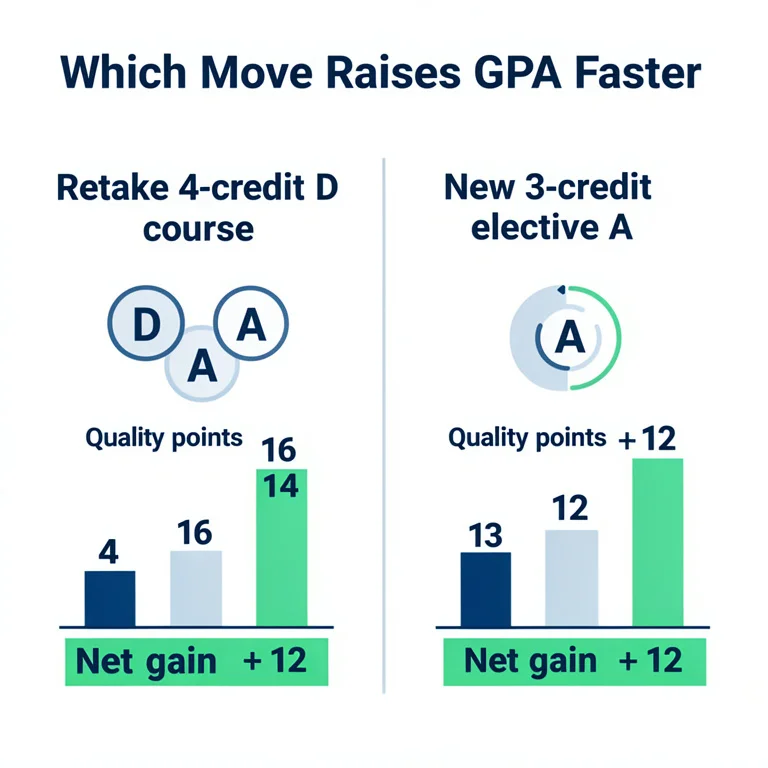
Retaking a course under a grade replacement policy removes the original grade from the GPA calculation and substitutes the new grade. Replacing a D (1.0) with an A (4.0) in a 4-credit course produces a net quality point gain of 12 — identical to earning an A in a new 3-credit course but without adding to the attempted credit total.
Grade replacement is the highest-leverage move available to students with low grades in high-credit courses. Three retake scenarios and their GPA impact on a student with 2.5 GPA on 60 credits:
- Retaking a 4-credit D (1.0) course and earning an A (4.0): net quality point gain of 12 with no denominator growth. New cumulative GPA = (150 − 4 + 16) ÷ 60 = 2.70
- Retaking a 3-credit F (0.0) course and earning a B (3.0): net quality point gain of 9 with no denominator growth. New cumulative GPA = (150 + 9) ÷ 60 = 2.65
- Retaking a 4-credit F (0.0) course and earning an A (4.0): net quality point gain of 16 with no denominator growth. New cumulative GPA = (150 + 16) ÷ 60 = 2.77
Grade replacement policies vary by institution. Some schools replace the original grade entirely; others average both attempts; others keep both grades on the transcript but use only the new grade in GPA calculations. Students should confirm their institution's exact policy in the academic catalog before retaking any course.
What is the fastest realistic path from 2.5 to 3.0?
The fastest realistic path from 2.5 to 3.0 combines grade replacement on existing low-grade high-credit courses with a 3.8 to 4.0 semester average on all new coursework. Students with 30 to 45 completed credits can reach 3.0 within 1 to 2 semesters; students with 60 or more credits should plan for 3 to 5 semesters.
Four actions ranked by GPA impact per semester:
- Identify all D and F grades in courses that offer grade replacement and retake the highest-credit ones first, starting with any 4-credit course where a D or F exists.
- Take 15 credits per semester rather than overloading at 18 credits. A 15-credit semester at 4.0 produces 60 new quality points. An 18-credit semester at 3.3 produces 59.4 quality points — less total gain with higher academic risk.
- Prioritise courses where grading is objective and performance is measurable — mathematics, accounting, computer science, and laboratory sciences — rather than subjective courses where grade outcomes depend on participation and essays.
- Track the cumulative GPA after every grade posts using the free GPA calculator at gpacalculator.uk to confirm the trajectory is on pace and adjust course selection for the next semester accordingly.
What GPA is achievable from 2.5 within a single semester?
The maximum GPA achievable from 2.5 in one 15-credit semester depends entirely on completed credits. A student with 30 credits can reach 3.0 exactly. A student with 60 credits can reach only 2.80 even with straight A's. A student with 90 credits can reach only 2.71 with straight A's.
Maximum reachable GPA in one 15-credit straight-A semester by starting credit total:
| Starting Credits | Starting GPA | Max GPA After 15 All-A Credits |
|---|---|---|
| 15 | 2.5 | 3.25 |
| 30 | 2.5 | 3.00 |
| 45 | 2.5 | 2.88 |
| 60 | 2.5 | 2.80 |
| 90 | 2.5 | 2.71 |
| 120 | 2.5 | 2.66 |
Students with 60 or more credits at 2.5 cannot reach 3.0 in a single semester by any means. Recognising this prevents the common mistake of planning for an unrealistic one-semester turnaround and instead prompts a multi-semester strategy with consistent 3.8 to 4.0 performance. For detailed credit-by-credit projections, the guide on how many A's it takes to raise GPA by 0.1 provides the underlying math for any starting GPA. Students recovering from a difficult semester can also review the academic recovery guide for a structured plan. All academic GPA guides are available in the resources section at gpacalculator.uk/resources.
Frequently Asked Questions
Can you raise a 2.5 GPA to 3.0 in one semester?
How many semesters does it take to raise a 2.5 GPA to 3.0?
Does retaking a class help raise a 2.5 GPA?
What GPA do I need each semester to go from 2.5 to 3.0?
Is a 2.5 GPA good enough for graduate school?
Written by
Adnan Ajmal
Software Developer
Adnan built GPA Calculator to give students a free, transparent tool for tracking their academic standing. All formulas follow the standard weighted average method used by US university registrars. Learn more about this site.
Related Articles

Online Student GPA: Do Online Classes Count the Same as In-Person
Online classes count toward GPA in exactly the same way as in-person classes at the vast majority of US colleges. The grade enters the same credit-weighted formula and produces identical quality points. Three specific conditions can change this: pass/fail grading, transfer credits from another institution, and the accreditation status of the originating school.

Community College Transfer GPA: What Four-Year Schools Really Look For
Transferring from a community college to a four-year university depends more heavily on grade point average (GPA) than any other single factor in the application. The thresholds that matter, however, vary sharply by institution type, target major, and whether an articulation agreement covers the transfer pathway.

Homeschool GPA: How to Calculate and Present It to Colleges
Homeschool families are responsible for calculating their student's GPA without a registrar, a standardised grading system, or institutional backing. A correctly built homeschool GPA, supported by a coherent transcript and verifiable documentation, carries full weight in college admissions and scholarship decisions.

Non-Traditional Student GPA: Returning to College After Years Away
More than 36 million adults in the US hold some college education but no credential. Returning students who re-enroll after years away face GPA challenges that differ in specific and predictable ways from those of traditional students, including decisions about old transcripts, academic forgiveness policies, and rebuilding study skills after a long break.