How to Calculate Cumulative GPA Across Multiple Semesters
Cumulative GPA is the credit-weighted average of all grade points earned across every semester attempted. Calculating it requires multiplying each semester's GPA by its credit hours, summing all quality points, then dividing by total credit hours — never averaging semester GPAs directly.
Free GPA Calculator
Calculate your GPA instantly

Cumulative Grade Point Average (GPA) is the single number that colleges, graduate programs, and employers use to evaluate a student's full academic record. Calculating cumulative GPA across multiple semesters requires a credit-weighted formula — not a simple average of semester GPAs. One low-credit semester and one high-credit semester carry different weight, and ignoring that distinction produces an inaccurate result.
What is the formula for calculating cumulative GPA?
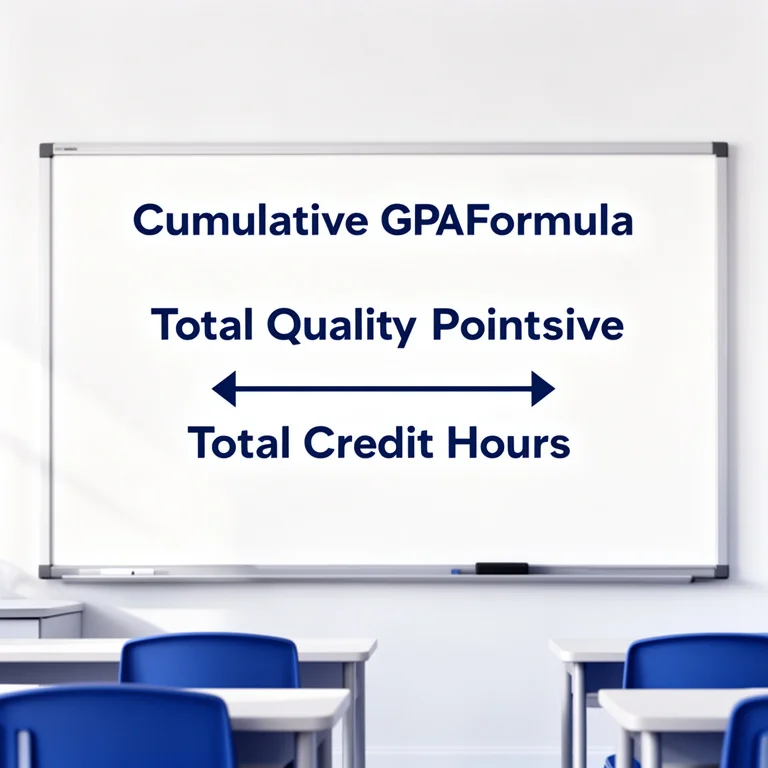
Cumulative GPA equals total quality points divided by total credit hours attempted. Quality points for each course equal the grade point value multiplied by the credit hours for that course. Sum all quality points across every semester, then divide by the total credit hours.
The formula:
Cumulative GPA = Total Quality Points ÷ Total Credit Hours Attempted
Where quality points per course = Grade Point × Credit Hours
Grade point values on the standard 4.0 scale:
| Letter Grade | Grade Point |
|---|---|
| A / A+ | 4.0 |
| A− | 3.7 |
| B+ | 3.3 |
| B | 3.0 |
| B− | 2.7 |
| C+ | 2.3 |
| C | 2.0 |
| C− | 1.7 |
| D+ | 1.3 |
| D | 1.0 |
| F | 0.0 |
Some institutions use a 4.33 scale where A+ equals 4.33. Students should verify their school's grading scale before calculating manually.
How do you calculate cumulative GPA step by step?
Collect every course grade and credit hour value, convert each grade to a grade point, multiply by the credit hours to get quality points per course, sum all quality points across all semesters, sum all credit hours, then divide total quality points by total credit hours.
Follow these five steps:
- Gather the complete transcript — every course attempted across every semester, including failed and repeated courses unless the school uses a grade forgiveness policy.
- Convert each letter grade to its grade point value using the 4.0 scale table.
- Multiply each course's grade point by its credit hours to calculate quality points for that course. A grade of B (3.0) in a 4-credit course produces 12.0 quality points.
- Add all quality points from all courses across all semesters to produce a single total.
- Add all attempted credit hours from all courses across all semesters to produce a single denominator.
- Divide total quality points by total credit hours and round to two decimal places.
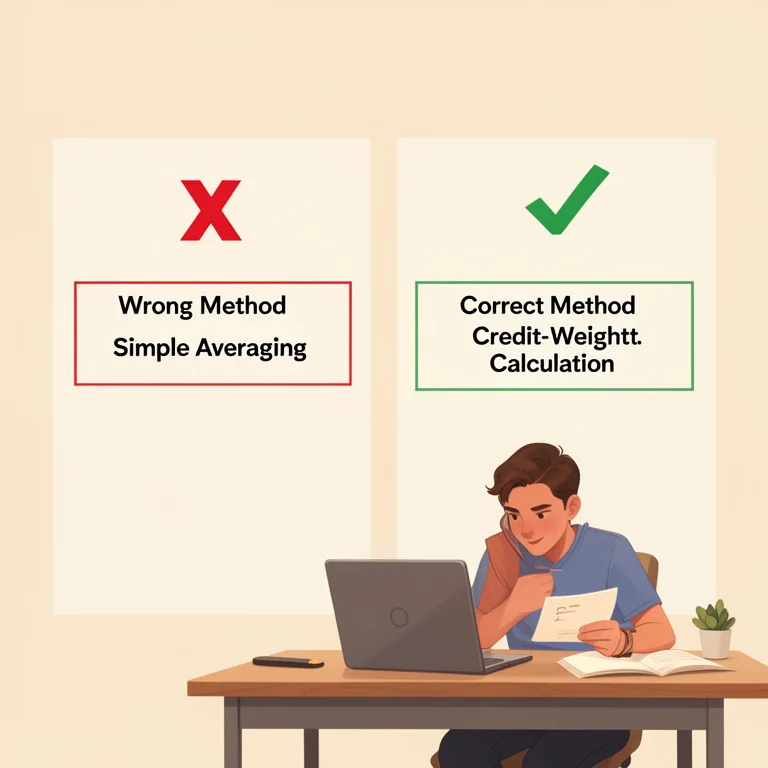
The key rule: never add semester GPAs together and divide by the number of semesters. That method ignores credit-hour differences between terms and produces a mathematically incorrect result whenever semester credit loads vary.
What does a full worked example of cumulative GPA look like across four semesters?
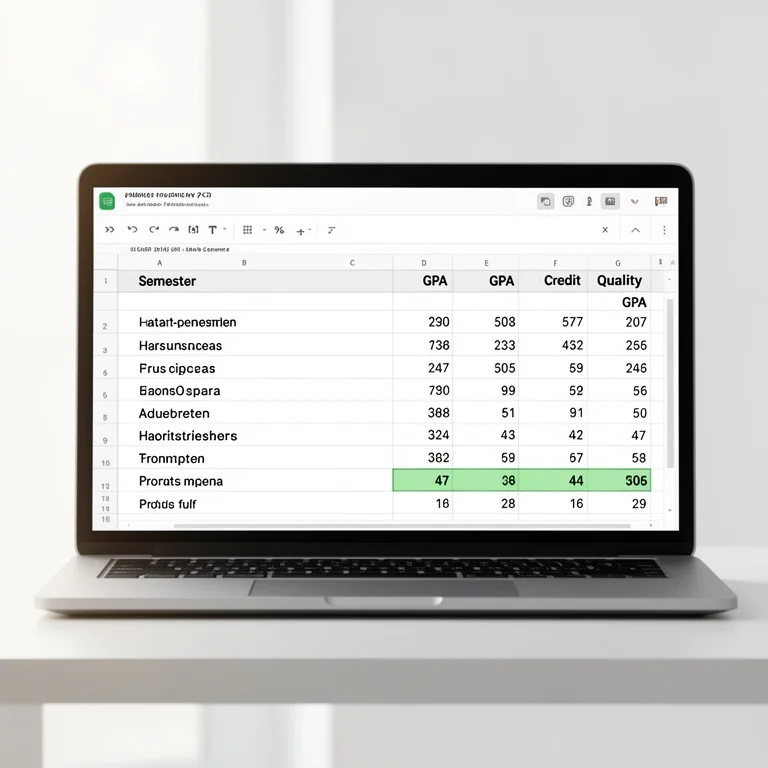
A student completing four semesters with credit hours of 15, 12, 18, and 15 and semester GPAs of 3.8, 3.2, 3.5, and 3.9 earns a cumulative GPA of 3.62 — not 3.60, which is what simple averaging incorrectly produces.
Here is the complete calculation:
| Semester | GPA | Credit Hours | Quality Points |
|---|---|---|---|
| Fall Year 1 | 3.8 | 15 | 57.0 |
| Spring Year 1 | 3.2 | 12 | 38.4 |
| Fall Year 2 | 3.5 | 18 | 63.0 |
| Spring Year 2 | 3.9 | 15 | 58.5 |
| Totals | — | 60 | 216.9 |
Cumulative GPA = 216.9 ÷ 60 = 3.615, rounded to 3.62
Simple averaging of the four semester GPAs: (3.8 + 3.2 + 3.5 + 3.9) ÷ 4 = 3.60
The difference of 0.015 exists because Fall Year 2 carried 18 credit hours at a 3.5 GPA, pulling the credit-weighted result slightly lower than the unweighted average. In longer academic careers spanning 8 semesters with more variation in credit loads, this difference can reach 0.1 to 0.2 GPA points — enough to cross scholarship cutoffs or academic standing thresholds.
Why does credit-hour weighting matter when calculating cumulative GPA?
Credit-hour weighting matters because a 4-credit course contributes four times more to cumulative GPA than a 1-credit course. Semesters with heavier course loads exert proportionally more influence on the cumulative result than light semesters.
Three scenarios where credit-hour differences change the outcome:
- A student who earns a 2.0 in a 4-credit core science course and a 4.0 in a 1-credit physical education elective loses more cumulative GPA than the elective A can recover.
- A student whose fall semester carries 18 credits at a 3.2 and whose spring carries 9 credits at a 3.8 ends the year with a cumulative GPA closer to 3.4 than 3.5, because the heavier fall semester dominates the calculation.
- A transfer student entering with 60 prior credits at a 3.0 and earning 30 credits at a 3.8 at the new institution ends with a combined cumulative GPA near 3.27, not 3.4, because the larger prior credit block carries more weight.
Academic advisors at institutions including the University of California system and Big Ten universities confirm that the credit-weighted formula is the standard used for all academic standing decisions, including probation at below 2.0, Dean's List eligibility typically at 3.5, and Latin honors typically beginning at 3.5 for cum laude.
What are the most common mistakes when calculating cumulative GPA?
The most common mistakes are averaging semester GPAs directly without credit-hour weighting, omitting failed or withdrawn courses that count as attempted hours, and using the wrong grade point value for plus and minus grades such as A− (3.7) versus A (4.0).
Specific errors and their corrections:
- Averaging semester GPAs directly — Produces the wrong result whenever semesters carry different credit loads. Correction: always use the quality-points formula.
- Omitting grade plus and minus distinctions — Treating B+ as B loses 0.3 grade points per affected course. Correction: use the full grade point table with +/− distinctions.
- Excluding failed courses — An F earns 0 quality points but the credit hours still count as attempted hours in the denominator. Omitting the course inflates the result. Correction: include all attempted courses including failures.
- Applying grade forgiveness incorrectly — Some schools replace the old grade in GPA calculations when a course is retaken; others include both attempts. Students must check the specific institutional policy before excluding any course grade.
- Using wrong scale for the institution — A school using a 4.33 scale assigns 4.33 to A+ rather than 4.0. Using the 4.0 scale at such institutions produces a lower-than-actual cumulative GPA for students with A+ grades.
How does cumulative GPA differ from semester GPA?
Semester GPA measures academic performance in one term only, calculated by dividing quality points earned that term by credit hours attempted that term. Cumulative GPA measures performance across all terms combined and is the figure used for graduation requirements, scholarships, and graduate admissions.
The two metrics serve different purposes. Semester GPA flags immediate performance trends — a single bad semester produces a low semester GPA but may lower cumulative GPA by only 0.05 to 0.15 points depending on how many total credits the student has accumulated. A student with 90 completed credits entering a final semester has locked in most of the cumulative GPA; the last 15 credits can shift the total by at most 0.1 to 0.2 points.
Cumulative GPA appears on official transcripts, graduate school applications, and employer background checks. Semester GPA appears on academic standing reports and progress notifications but does not replace the cumulative figure on transcripts. Students monitoring recovery after a difficult semester should calculate both: semester GPA to measure immediate improvement, and cumulative GPA to track progress toward a target threshold. The cumulative vs semester GPA comparison guide on this site explains both calculations in full detail.
How many semesters does it take to raise cumulative GPA by 0.1?
Raising cumulative GPA by 0.1 requires earning straight A grades (4.0) across approximately 10 to 20 percent of total attempted credit hours, depending on the starting GPA. A student with 60 credits at 3.0 needs roughly 15 additional credits of 4.0 work to reach 3.1.
The formula for estimating recovery credits:
Target GPA × (Current Credits + Additional Credits) = (Current GPA × Current Credits) + (4.0 × Additional Credits)
Solving for Additional Credits:
Additional Credits = (Current Credits × (Target GPA − Current GPA)) ÷ (4.0 − Target GPA)
Example: Current GPA 3.0 on 60 credits, target 3.1:
Additional Credits = (60 × 0.1) ÷ (4.0 − 3.1) = 6 ÷ 0.9 = 6.67 credits
Rounded up to 9 credits (one full semester of 3-credit courses), all earned at A, raises the cumulative GPA from 3.0 to approximately 3.08. The article how many A's it takes to raise GPA by 0.1 provides semester-by-semester tables for every starting GPA level.
For a full step-by-step academic planning tool, use the free GPA calculator at gpacalculator.uk to enter every semester's data and see the cumulative result instantly. The calculator handles plus and minus grades, variable credit hours, and transfer credit inputs.
For broader guidance on grade improvement strategies, the resources section at gpacalculator.uk/resources contains guides on semester planning, grade point recovery, and program-specific GPA benchmarks.
Frequently Asked Questions
How do you calculate cumulative GPA from semester GPAs?
Does a failed class affect cumulative GPA?
Can you calculate cumulative GPA without individual course grades?
Why is my calculated cumulative GPA different from my transcript?
How many credits does it take to raise cumulative GPA by 0.1?
Written by
Adnan Ajmal
Software Developer
Adnan built GPA Calculator to give students a free, transparent tool for tracking their academic standing. All formulas follow the standard weighted average method used by US university registrars. Learn more about this site.
Related Articles

PhD Program GPA Requirements: What Admissions Committees Actually Look For
PhD admissions committees evaluate GPA through three lenses: trajectory (did grades improve over time?), subject alignment (were strong grades earned in relevant courses?), and institutional context (what does this GPA represent at this institution?). The minimum stated threshold is 3.0 at most programmes; the competitive threshold for admission at programmes of significant quality is 3.5 or above.

Academic Dismissal and GPA: Your Options for Readmission
Academic dismissal is the formal separation of a student from their institution after sustained failure to meet minimum GPA standards, typically a 2.0 cumulative average. Most institutions provide a structured readmission pathway through a formal appeal process, a required separation period of one academic year, and specific academic conditions attached to reinstatement.

Grade Forgiveness Policies: Which Colleges Offer Second Chances
Grade forgiveness policies, also called academic renewal, fresh start, or grade replacement depending on the institution, allow students to reduce or eliminate the GPA impact of previously earned failing grades. The original grades remain on the transcript in nearly all cases but are excluded from the cumulative GPA calculation. Graduate and professional school applications, including AMCAS and LSAC, typically include all attempted courses regardless of institutional forgiveness.

AP Exam Scores vs AP Class Grades: Which Matters More for GPA
AP class grades enter the high school weighted GPA calculation directly. AP exam scores do not. An A in AP Chemistry earns 5.0 weighted quality points regardless of what score the student earns in May. However, colleges use AP exam scores as an external benchmark to evaluate whether class grades reflect genuine mastery, and in the current test-optional environment, this evaluative role has grown.