GPA vs Class Rank: Which Matters More for College Admissions
GPA carries more weight than class rank in college admissions. According to NACAC data, only 9% of colleges rate class rank as considerably important compared to 23% in 2007, while over 75% of colleges list overall GPA as a top admissions factor.
Free GPA Calculator
Calculate your GPA instantly

Grade Point Average (GPA) and class rank both measure academic performance, but colleges weight them differently. GPA is a direct measure of a student's grades across all courses. Class rank is a relative measure that compares a student's GPA to all other students in the same graduating class. According to the National Association for College Admission Counseling (NACAC), over 75% of colleges list overall GPA as a top admissions factor, while only 9% rate class rank as considerably important.
Does GPA or class rank matter more for college admissions?
GPA matters more than class rank for college admissions at most institutions. NACAC data shows that 75% of colleges list overall GPA as a top admissions factor, while only 9% rate class rank as considerably important — down from 23% in 2007.
The shift reflects two converging trends: more high schools have stopped reporting class rank, and more colleges have adopted holistic review processes that evaluate course rigor, essays, recommendations, and extracurricular involvement alongside raw academic metrics. A student's GPA, contextualised against the school profile submitted by the counselor, gives admissions officers more actionable information than a rank number alone.

How do colleges use GPA in admissions decisions?
Colleges use GPA as the primary quantitative measure of academic performance. Over 73% of colleges rate grades in college preparatory courses as a top admissions factor, and 60% rate strength of curriculum — meaning course rigor sits alongside the GPA number in every evaluation.
GPA does not travel alone in an admissions file. Colleges receive a school profile alongside the transcript, which documents the full range of courses offered, the grading scale, and the academic environment. A 3.7 GPA at a school offering 20 Advanced Placement (AP) courses reads differently than a 3.7 GPA at a school offering 4 AP courses. Admissions officers at selective colleges routinely recalculate applicant GPAs using a standardized formula — the University of California system recalculates every applicant using its own 10th to 12th grade core course formula — making the school-reported GPA a starting point rather than a final number.
Three contexts where GPA carries the most weight:
- Large public universities receiving 40,000 or more applications per cycle, where GPA and test scores drive first-pass filtering before holistic review begins
- Merit scholarship committees at regional universities, where GPA thresholds determine award eligibility before other factors are evaluated
- Graduate and professional school applications, where undergraduate cumulative GPA on the 4.0 scale is a primary screening metric alongside standardized tests
How do colleges use class rank in admissions decisions?
Class rank gives admissions officers a peer-relative benchmark when the high school reports it. Selective private colleges, including Harvard, no longer consider class rank. Most large public universities still factor rank in, particularly for automatic admission programs that guarantee acceptance to students in the top 6 to 10 percent of their class.
The College Board reports that more than half of all high schools no longer report student rankings. Small private high schools eliminated rank first, arguing that the metric penalizes strong students who attend highly competitive schools where top 10% placement is harder to achieve. Public flagship universities in Texas still operate automatic admission programs tied to class rank — the University of Texas at Austin admits students in the top 6% of their graduating class automatically under state law.
Three scenarios where class rank still carries weight:
- Texas public universities operating under the Top 10 Percent Rule and similar automatic admission statutes
- Military service academies, including the United States Naval Academy and West Point, which factor class rank in their congressional nomination and selection processes
- Scholarship programs, including National Merit recognition and institutional merit awards, where class rank supplements GPA in candidate evaluation

What happens when a student has a high GPA but a low class rank?
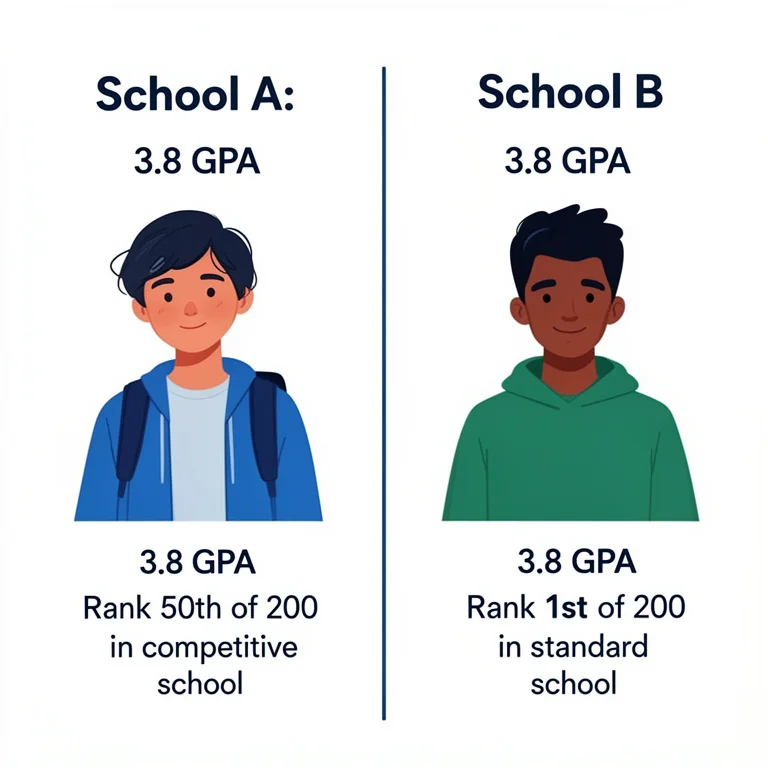
A high GPA paired with a low class rank signals to admissions officers that the student attends a highly competitive school where strong grades are harder to earn. Admissions officers interpret this combination using the school profile and regard it as evidence of a rigorous academic environment rather than weak performance.
A student graduating with a 3.8 GPA at a high school where 40% of students hold GPAs above 3.7 may rank 50th in a class of 200. A 3.8 GPA at a school where few students take AP courses may place that same student first. Neither rank tells the full story without the school profile. NACAC data confirms that colleges increasingly rely on GPA plus course rigor as the primary academic signal, with class rank serving as supplemental context rather than a decisive factor.
What happens when a student has a high class rank but a lower GPA?
A high class rank with a lower absolute GPA tells admissions officers that the student outperformed peers in the same academic environment. Colleges interpret a top-5% rank with a 3.3 GPA more favorably when the school average GPA is 2.9 than when the school average is 3.6.
Class rank compensates for schools with grade deflation — environments where teachers assign fewer A grades than the national average. A student with a 3.2 cumulative GPA who ranks 12th in a class of 300 at a school with documented grade deflation presents a stronger academic signal than the rank number alone suggests.
Should a student focus on raising GPA or class rank?
Students should focus on GPA, not class rank. Improving GPA requires higher grades across all courses. Improving class rank depends on outperforming peers, which students cannot directly control. Every college that considers class rank also considers GPA, but not every college that considers GPA also considers class rank.
The practical strategy: take the most challenging courses available, earn the highest grades possible in those courses, and track cumulative GPA each semester. Students monitoring GPA progress can use the free GPA calculator at gpacalculator.uk to calculate the current GPA and project future semester targets. For students with a specific GPA goal, the article on how many A's it takes to raise GPA by 0.1 provides the exact credit-weighted math. For context on how cumulative GPA differs from semester GPA, the guide on cumulative GPA vs semester GPA covers both calculations. All academic planning resources are in the resources section at gpacalculator.uk/resources.
Frequently Asked Questions
Does GPA or class rank matter more for college?
Do Ivy League schools look at class rank?
What percentage class rank is good for college admissions?
Is a 4.0 GPA with a low class rank bad for college admissions?
Do colleges calculate their own GPA from your transcript?
Written by
Adnan Ajmal
Software Developer
Adnan built GPA Calculator to give students a free, transparent tool for tracking their academic standing. All formulas follow the standard weighted average method used by US university registrars. Learn more about this site.
Related Articles

PhD Program GPA Requirements: What Admissions Committees Actually Look For
PhD admissions committees evaluate GPA through three lenses: trajectory (did grades improve over time?), subject alignment (were strong grades earned in relevant courses?), and institutional context (what does this GPA represent at this institution?). The minimum stated threshold is 3.0 at most programmes; the competitive threshold for admission at programmes of significant quality is 3.5 or above.

Academic Dismissal and GPA: Your Options for Readmission
Academic dismissal is the formal separation of a student from their institution after sustained failure to meet minimum GPA standards, typically a 2.0 cumulative average. Most institutions provide a structured readmission pathway through a formal appeal process, a required separation period of one academic year, and specific academic conditions attached to reinstatement.

Grade Forgiveness Policies: Which Colleges Offer Second Chances
Grade forgiveness policies, also called academic renewal, fresh start, or grade replacement depending on the institution, allow students to reduce or eliminate the GPA impact of previously earned failing grades. The original grades remain on the transcript in nearly all cases but are excluded from the cumulative GPA calculation. Graduate and professional school applications, including AMCAS and LSAC, typically include all attempted courses regardless of institutional forgiveness.

AP Exam Scores vs AP Class Grades: Which Matters More for GPA
AP class grades enter the high school weighted GPA calculation directly. AP exam scores do not. An A in AP Chemistry earns 5.0 weighted quality points regardless of what score the student earns in May. However, colleges use AP exam scores as an external benchmark to evaluate whether class grades reflect genuine mastery, and in the current test-optional environment, this evaluative role has grown.