How to Raise Your GPA in One Semester
Raising GPA in one semester is possible, but the gain is capped by total completed credits. A student with 30 credits can gain up to 0.5 GPA points in one 15-credit all-A semester. A student with 90 credits gains at most 0.17 points from the same performance.
Free GPA Calculator
Calculate your GPA instantly
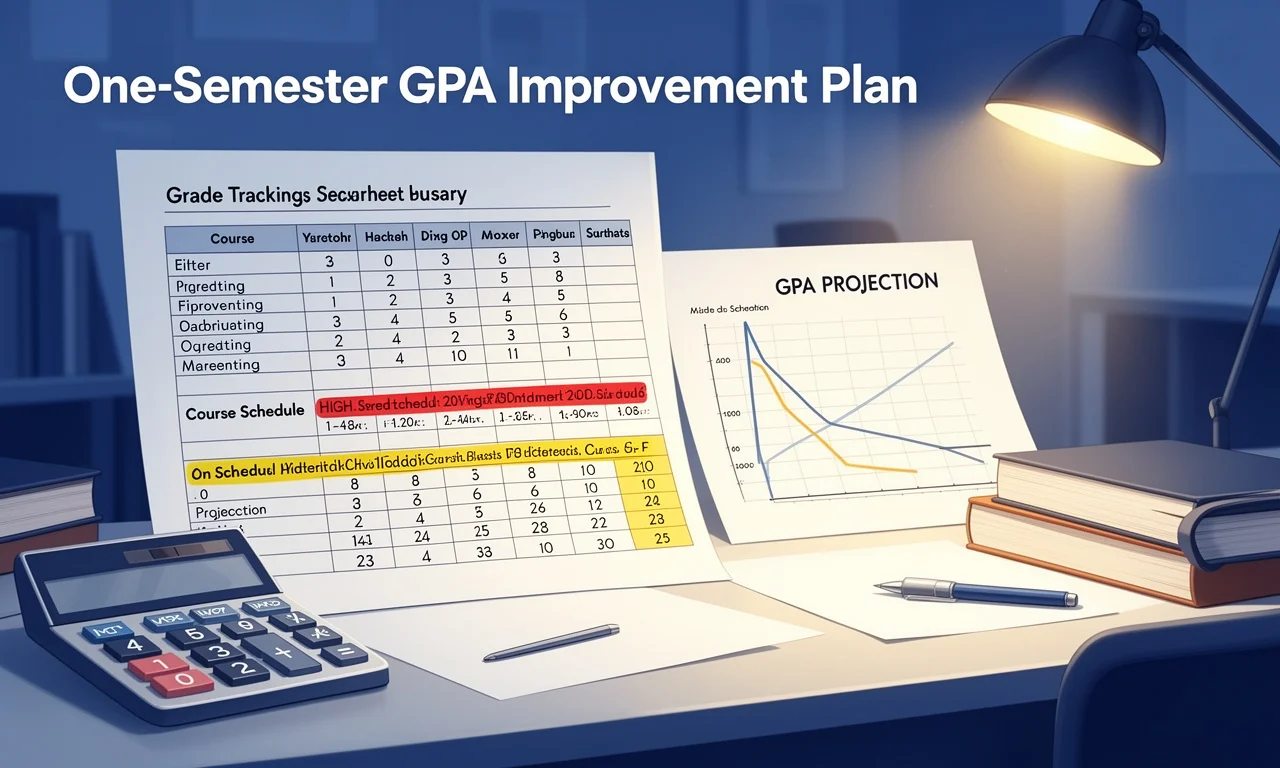
Raising a Grade Point Average (GPA) in one semester is possible, but the size of the gain depends on two variables: the number of credit hours already completed and the semester GPA earned in the current term. A student with 30 completed credits who earns a 4.0 semester GPA gains approximately 0.5 GPA points. A student with 90 completed credits who earns the same 4.0 gains only 0.17 GPA points. The math sets the ceiling — strategy determines whether that ceiling is reached.
How much can GPA realistically increase in one semester?
The maximum GPA increase achievable in one 15-credit semester at a 4.0 average ranges from 0.50 at 30 completed credits to 0.13 at 120 completed credits. Students earlier in their academic career gain more per semester than those with large accumulated credit totals.
The formula for calculating the new cumulative GPA after any semester:
New Cumulative GPA = (Current GPA × Current Credits + Semester GPA × Semester Credits) ÷ (Current Credits + Semester Credits)
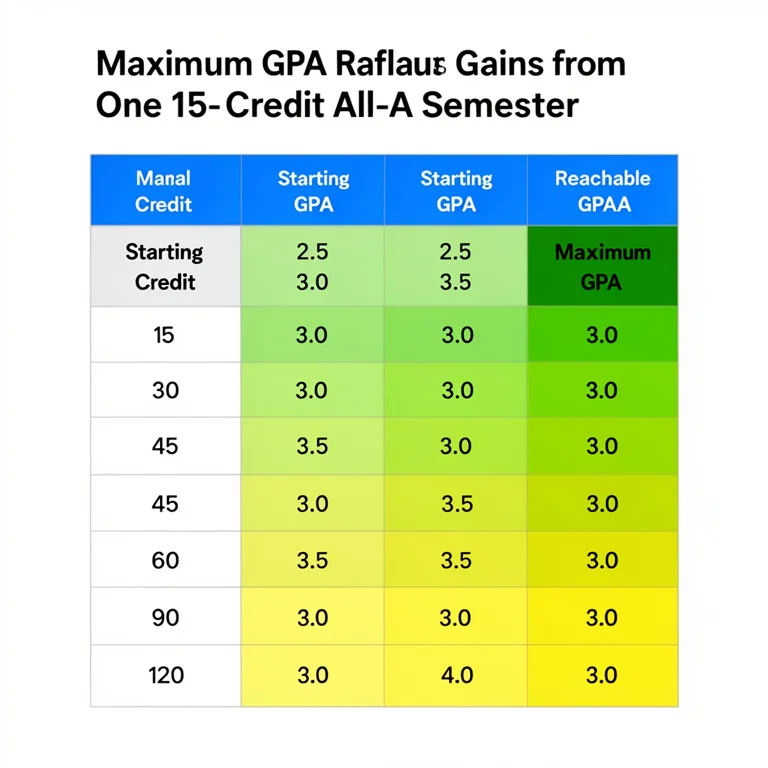
Maximum cumulative GPA achievable after one 15-credit all-A semester by starting credit total:
| Starting Credits | Starting GPA 2.5 | Starting GPA 3.0 | Starting GPA 3.5 |
|---|---|---|---|
| 15 | 3.25 | 3.50 | 3.75 |
| 30 | 3.00 | 3.33 | 3.67 |
| 45 | 2.88 | 3.25 | 3.63 |
| 60 | 2.80 | 3.20 | 3.60 |
| 90 | 2.71 | 3.14 | 3.57 |
| 120 | 2.66 | 3.11 | 3.56 |
A student with 60 completed credits and a 3.0 GPA who earns a perfect 4.0 semester reaches only 3.20, not 3.5 or 4.0. Recognising this ceiling before the semester starts prevents planning for a target that one semester cannot mathematically reach and redirects effort toward the strategies that extract the maximum realistic gain.
Which courses should receive the most attention for GPA recovery?
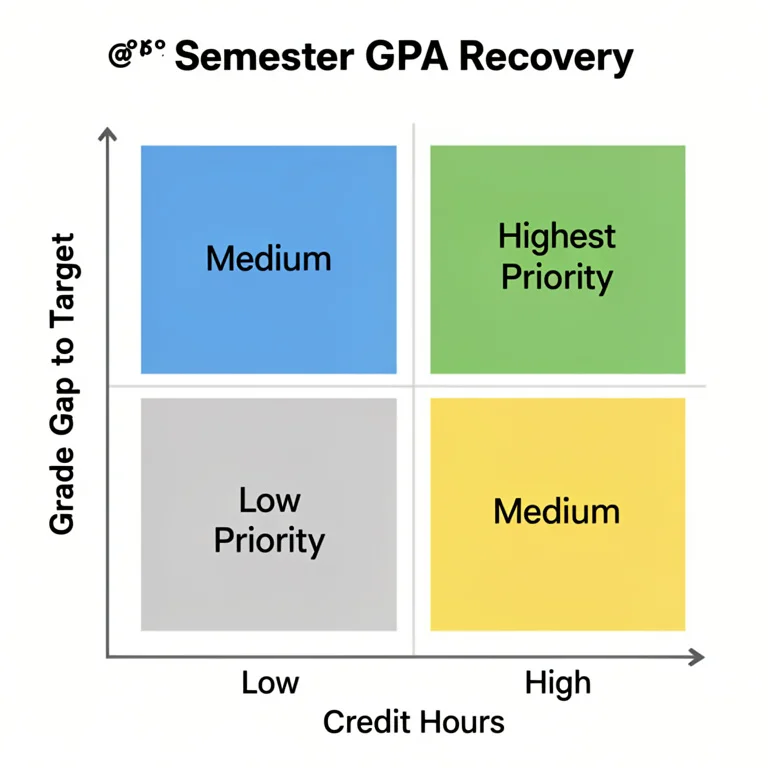
Students raising GPA in one semester should prioritise the highest-credit courses where the current grade sits farthest below the target. A 4-credit course where the student holds a C contributes 8 fewer quality points than a 4.0, and closing that gap produces more GPA movement than any other single course action.
The course priority calculation: Grade Gap × Credit Hours = Quality Points at Stake
Three examples for a student with a 3.0 GPA on 60 credits taking 15 new credits across 5 courses:
- 4-credit course at C (2.0): grade gap of 2.0 grade points × 4 credits = 8 quality points recoverable. Raising to A adds 8 quality points and lifts the semester average by 0.53 on a 15-credit load.
- 3-credit course at B (3.0): grade gap of 1.0 grade point × 3 credits = 3 quality points recoverable. Raising from B to A adds 3 quality points, which is less impactful per course than the 4-credit recovery above.
- 1-credit course at C (2.0): grade gap of 2.0 grade points × 1 credit = 2 quality points recoverable. Raising to A in a 1-credit seminar produces minimal GPA movement despite the same two-letter-grade improvement.
Students should rank every enrolled course by quality points at stake and allocate additional study hours in that order rather than spreading effort equally across all courses.
What specific actions raise GPA the fastest within one semester?
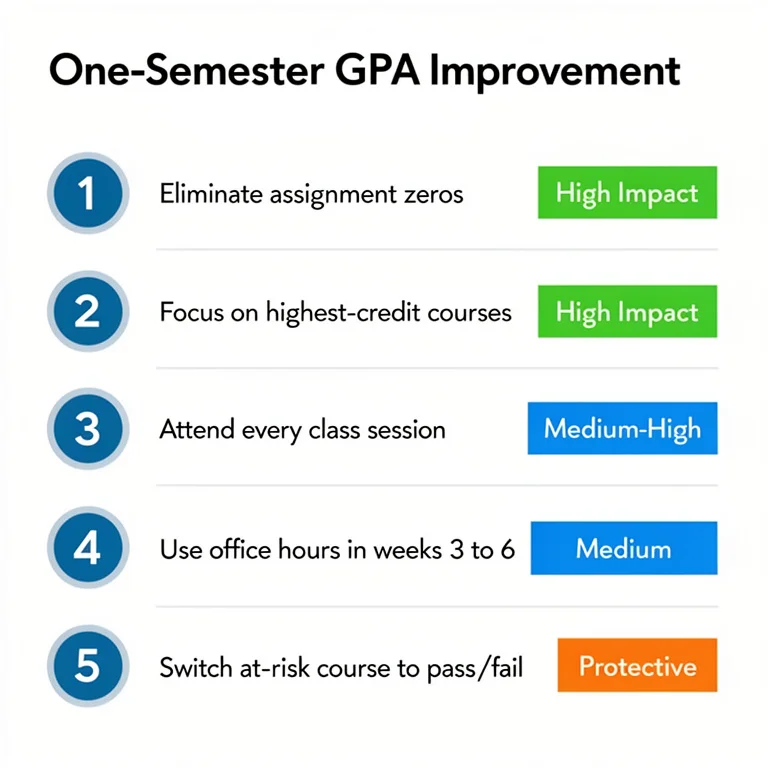
The five highest-impact actions within one semester are: eliminating assignment zeros, focusing extra effort on the highest-credit courses, attending every class session, visiting professor office hours in weeks 3 to 6, and switching any at-risk course to pass/fail before the institutional deadline.
Each action targets a different source of GPA loss:
- Eliminate zeros on graded assignments. A single zero on a 100-point assignment worth 15% of the final course grade requires a score above 100% on the next assignment to fully compensate, which is mathematically impossible on a standard grading scale. Submitting incomplete work for partial credit recovers more quality points than a zero in every case.
- Focus study time on the highest-credit courses first. A one-letter-grade improvement in a 4-credit course produces 4 additional quality points. The same improvement in a 1-credit course produces 1. Students with limited study hours gain more by concentrating on high-credit courses before optimising low-credit ones.
- Attend every class session. Participation credit at institutions awarding 5 to 15% of the course grade for attendance and discussion can shift a B− (2.7) to a B+ (3.3) at the grade boundary, a 0.6 grade point swing on a 3-credit course that adds 1.8 quality points to the semester total.
- Use professor office hours in weeks 3 to 6. Students who meet with professors in the first third of the semester identify grading criteria mismatches before midterms, not after. Correcting a misunderstood assignment expectation before the midterm exam protects quality points that are otherwise permanently lost.
- Convert at-risk courses to pass/fail before the deadline. A projected D (1.0) in a 3-credit course removes 6 quality points below a 3.0 target and adds 3 credits to the attempted denominator. Converting to pass/fail and earning a P protects the cumulative GPA entirely. Most institutions set the pass/fail election deadline at weeks 4 to 6 of the semester.
Does semester credit load affect one-semester GPA gain?
A heavier semester credit load increases the potential GPA gain because more new credits elevate the cumulative average faster. A 18-credit semester at 4.0 raises GPA faster than a 12-credit semester at 4.0, but only when the higher load does not lower the average grade earned.
The GPA gain comparison for a student at 3.0 on 60 credits:
| Semester Credits | Semester GPA | New Cumulative GPA | Net Gain |
|---|---|---|---|
| 12 | 4.0 | 3.17 | +0.17 |
| 15 | 4.0 | 3.20 | +0.20 |
| 18 | 4.0 | 3.23 | +0.23 |
| 18 | 3.5 | 3.18 | +0.18 |
| 18 | 3.2 | 3.15 | +0.15 |
An 18-credit semester at 3.2 produces a smaller GPA gain than a 12-credit semester at 4.0. The optimal credit load for one-semester GPA recovery is the maximum number of credits where the student can realistically maintain a 3.8 to 4.0 average, typically 15 credits for most students and 12 credits for students managing work or family commitments above 20 hours per week.
How do high-credit courses affect one-semester GPA recovery speed?
High-credit courses, including laboratory sciences, engineering sequences, and writing-intensive seminars at 4 credits each, move cumulative GPA faster per course than 1-credit or 2-credit electives. Students holding five courses should earn A grades in the 4-credit courses before optimising the 1-credit ones.
Quality points earned per A grade by course credit value:
- 1-credit A course: 4.0 quality points added
- 2-credit A course: 8.0 quality points added
- 3-credit A course: 12.0 quality points added
- 4-credit A course: 16.0 quality points added
A student taking one 4-credit course and four 3-credit courses in a 16-credit semester who earns all A grades produces 64 total quality points. Replacing the 4-credit course with a 1-credit course while keeping all other grades at A produces only 52 quality points, a loss of 12 quality points from a single scheduling decision made before the semester began. Prioritising high-credit course registration during enrolment, before the semester starts, is the highest-leverage one-semester GPA action available.
What is the fastest path to raise GPA for students on academic probation?
Students on academic probation, typically defined as a cumulative GPA below 2.0, need a semester GPA between 2.5 and 3.5 to return to good standing within one term, depending on institutional policy and current credit total. Retaking previously failed high-credit courses under a grade replacement policy is the single fastest route.
Grade replacement removes the original F (0.0) from the quality points calculation and substitutes the new grade without adding to the attempted credit denominator. Retaking a 4-credit failed course and earning a B (3.0) adds 12 quality points while the denominator stays unchanged, the same gain as earning an A in a new 3-credit course but without requiring an additional enrolment slot in an already demanding recovery semester.
Students in academic probation status should calculate the minimum semester GPA required to exit probation using this formula: Required Semester GPA = (Target Cumulative GPA × Total Credits After Semester − Current Cumulative GPA × Current Credits) ÷ Semester Credits. Entering this calculation into the free GPA calculator at gpacalculator.uk confirms the exact target before the semester begins. For the underlying credit-weighted math behind any GPA gain target, the guide on how many A's it takes to raise GPA by 0.1 covers every starting scenario. Students managing the GPA impact of a failing or near-failing course should review the pass/fail GPA guide before the institutional election deadline. All GPA planning resources are available in the resources section at gpacalculator.uk/resources.
Frequently Asked Questions
How much can you raise your GPA in one semester?
Can you raise your GPA from 2.5 to 3.0 in one semester?
What is the fastest way to raise your GPA in one semester?
Does taking more classes raise GPA faster?
How do you raise GPA when on academic probation?
Written by
Adnan Ajmal
Software Developer
Adnan built GPA Calculator to give students a free, transparent tool for tracking their academic standing. All formulas follow the standard weighted average method used by US university registrars. Learn more about this site.
Related Articles

Summer School GPA: Does It Help or Hurt Your Cumulative Average
Summer school can raise, hold flat, or lower a cumulative GPA depending on where the course is taken and what grade is earned. A summer course at the home institution enters the GPA formula directly. A summer course at a community college or another institution typically contributes credit hours but not the grade, leaving the cumulative GPA unchanged regardless of performance.

Incomplete Grades and GPA: How I Grades Affect Your Academic Standing
An incomplete grade (I) is excluded from the GPA calculation while it remains active at most institutions, because it carries no grade point value. The consequential question is what the I converts to when the resolution deadline passes: at most institutions, an unresolved incomplete automatically becomes an F, entering GPA at 0.0 quality points per credit hour and producing the same damage as a failed course.

Failing a Class: How One F Affects Your GPA and What to Do Next
Failing a class earns 0.0 quality points per credit hour and adds those credits to the GPA denominator without raising the numerator. The exact impact depends on how many credits were completed before the failure: the same 3-credit F drops a 3.2 GPA by 0.53 points at 15 completed credits but only 0.20 points at 45 completed credits.

Senior Year College GPA: Finishing Strong for Employers and Grad School
Senior year college GPA is the final number on a permanent academic record that appears in employer background checks, graduate school transcript requests, and professional credential verifications. According to NACE's 2024 Job Outlook Report, 38.3% of employers screen candidates by GPA, making the four-year cumulative average that includes senior year directly consequential in the first years after graduation.