How to Score the Highest GPA in Your Class
Scoring the highest GPA in a class requires strategic course selection, within-semester grade management, and study methods calibrated to each assessment's weight. Students who reach 3.9 to 4.0 consistently do all three simultaneously.
Free GPA Calculator
Calculate your GPA instantly

Scoring the highest Grade Point Average (GPA) in a class requires three things working together: course selection that maximises quality points, a grade management system that identifies point losses before they compound, and study habits calibrated to the specific grading weight of each assessment. Students who consistently earn top GPAs — 3.9 to 4.0 across four semesters — do not simply study more hours; they allocate those hours to the assessments and courses that move the GPA number most.
What course selection strategy produces the highest GPA?
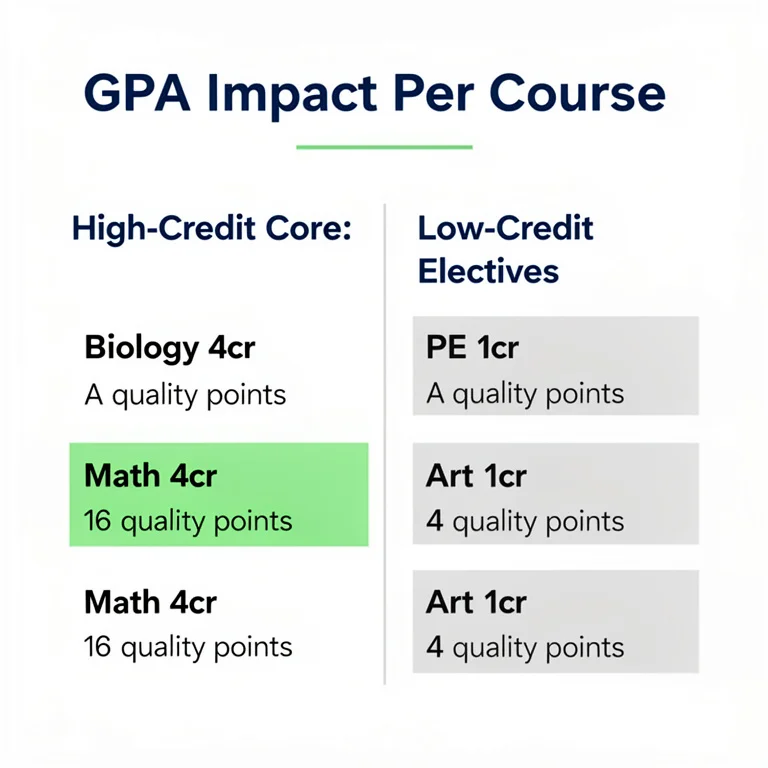
Students who score the highest GPAs prioritise high-credit core courses over low-credit electives, because a 4-credit A grade contributes 16 quality points while a 1-credit A grade contributes only 4. Taking 5 courses at 3 to 4 credits each delivers more GPA leverage per semester than mixing in multiple 1-credit courses.
Course selection is the highest-leverage GPA decision a student makes each semester, because the credit value of each course determines how much any grade — A, B, or C — affects the cumulative total.
Three course selection principles that top-GPA students apply consistently:
- Front-load high-credit courses in semesters where the student's schedule allows maximum study time, such as semesters without demanding extracurricular commitments or part-time work hours above 15 per week.
- Delay genuinely difficult high-credit courses, such as organic chemistry (4 credits), advanced calculus (4 credits), and thermodynamics (3 credits), to semesters where supporting resources — tutors, study groups, office hours — are accessible.
- Avoid stacking multiple high-difficulty high-credit courses in the same semester. A student taking organic chemistry, statistics, and macroeconomics simultaneously faces three high-stakes grading systems at once, increasing the probability that at least one course produces a B or lower.
How do students who rank first in GPA manage their grades within each course?
Top-GPA students track cumulative grade percentage in every course from week one, recalculate the grade needed on remaining assessments after each graded item returns, and contact the professor within 48 hours of any grade below their target — not at the end of the semester.
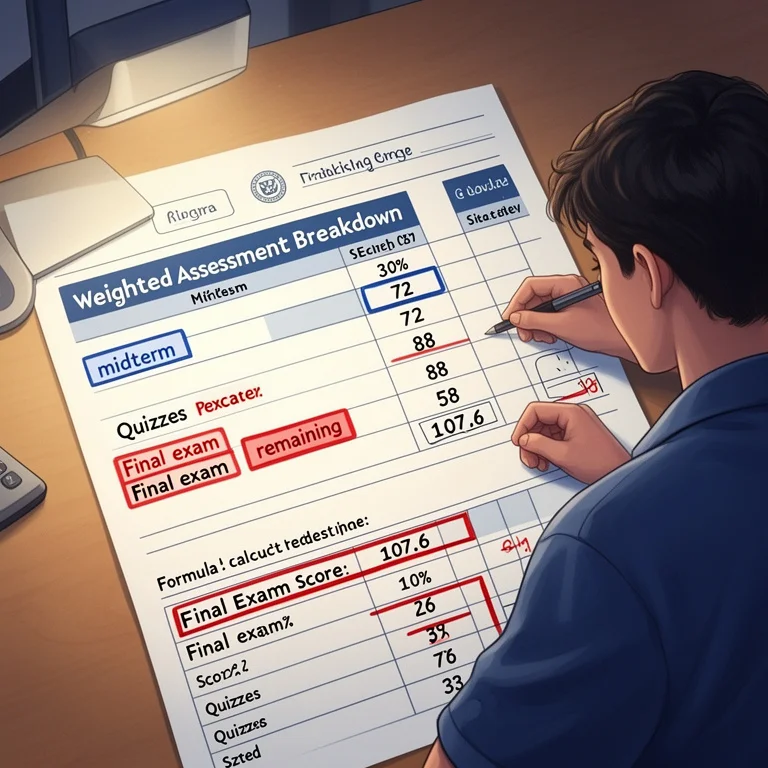
Grade management is a within-semester process, not a post-semester one. A student who earns 72% on a midterm worth 30% of the final grade has already absorbed a measurable deduction from the target A. Recovering requires calculating the exact final exam score needed to finish with a 90% or above.
The calculation: (Target Final Grade × 1.0) − (Sum of Weighted Scores Earned) ÷ Remaining Weight
Example: Target grade 93%, midterm 72% at 30% weight, quiz average 88% at 20% weight
Minimum final exam score = (93 − 0.30 × 72 − 0.20 × 88) ÷ 0.50 = (93 − 21.6 − 17.6) ÷ 0.50 = 107.6%
A 107.6% final exam requirement means the target A grade is mathematically out of reach. The student should immediately shift the target to B+ (88%) and identify any extra credit opportunities available. Students who catch this in week 8 have time to act; students who calculate it in week 15 do not.
What study methods produce the highest exam scores for GPA purposes?
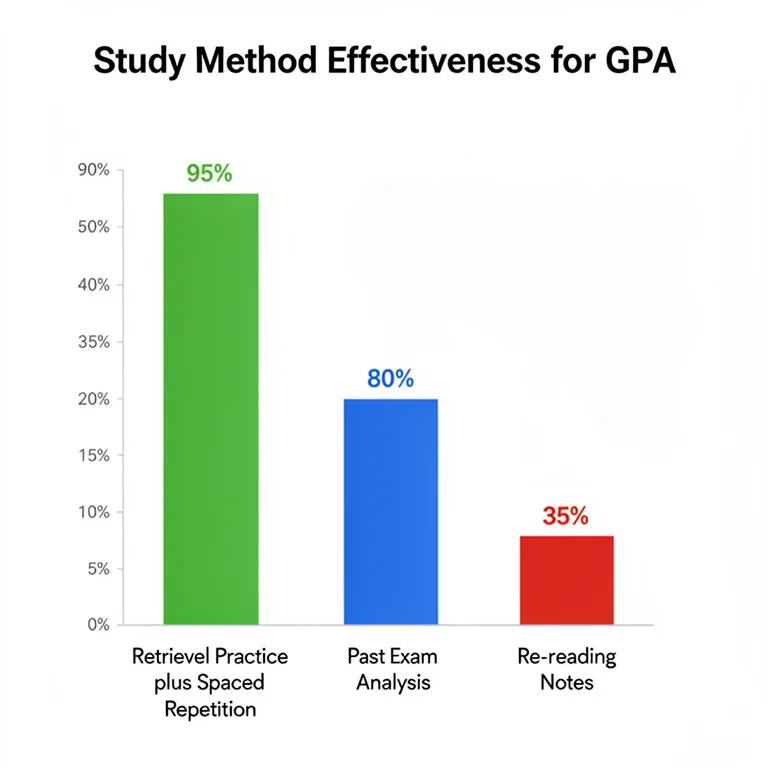
Retrieval practice — the act of recalling information from memory without looking at notes — produces 40 to 50% better long-term retention than re-reading, according to research published in Psychological Science. Students who replace passive review with active recall drills score higher on high-stakes exams.
Three study methods ranked by GPA impact per hour invested:
- Retrieval practice with spaced repetition: Study a topic, close all materials, write or say everything recalled, check against notes, repeat after 1 day, then 3 days, then 7 days. Applying this system across 6 to 8 weeks before an exam covers the material at the depth exams measure.
- Past exam analysis: Obtain past exams or professor-released exam keys, complete each exam under timed conditions, score against the answer key, and map wrong answers to specific topic gaps. Repeat with a new exam after addressing each gap.
- Interleaved practice: Alternate between different topics within one study session rather than completing one topic fully before moving to the next. Physics problems followed by chemistry problems followed by calculus, then repeating the cycle, produces stronger discrimination between concepts than blocked study.
Methods that high-GPA students avoid include re-reading highlighted notes (produces familiarity, not recall), studying in sessions above 90 minutes without breaks (performance degrades after 60 to 90 minutes of focused cognitive work), and studying in environments with phone notifications active (each notification interrupts attention for an average of 23 minutes of refocus time).
How does syllabus analysis affect GPA at the top of the class?
Students who read the full syllabus during the first week and identify which assessments carry the highest grade weight outperform students who study uniformly across all topics. A final exam worth 40% of the course grade deserves proportionally more preparation time than a quiz worth 5%.
Syllabus analysis produces a priority-weighted study schedule. A student enrolled in five courses each with different grading structures allocates study hours in proportion to each course's credit value and each assessment's grade weight within the course. Three syllabus factors that determine where study time produces the highest GPA return:
- Assessment weight distribution: Courses where a single final exam accounts for 50% or more of the grade require mastery of cumulative content. Courses where weekly quizzes account for 60% of the grade reward consistent short-cycle preparation.
- Grading curves and class participation: Some professors award up to 10% of the final grade for participation. Students who attend every class and ask substantive questions often receive participation credit that offsets a 2 to 3 percentage point gap between letter grade thresholds.
- Grade replacement and drop policies: Many courses drop the lowest quiz score or allow one assignment resubmission. Students who identify these policies on day one plan deliberately — submitting a draft for feedback before the deadline rather than relying on the drop as a safety net.
What GPA tracking habit separates students at the top from those with similar effort?
Students who calculate their cumulative GPA after every semester — not just at year-end — catch GPA drift before it becomes too large to correct. A 0.05 GPA drop in semester two is recoverable in semester three with 9 to 12 additional all-A credits. A 0.2 drop over four semesters requires 40 to 60 additional all-A credits to reverse.
GPA tracking at the course level, semester level, and cumulative level gives students three separate intervention points. At the course level, grade tracking within the semester catches problems while assessments remain. At the semester level, GPA calculation after grades post shows whether the cumulative trajectory shifted. At the cumulative level, projecting GPA forward using planned courses shows whether a target GPA is achievable before graduation.
Students monitoring semester-by-semester progress can enter each course grade into the free GPA calculator at gpacalculator.uk to see the updated cumulative result instantly. For the formula behind how credits affect cumulative GPA, the guide on how many A's it takes to raise GPA by 0.1 provides the exact math. Students comparing semester performance to the overall cumulative can review cumulative GPA vs semester GPA explained. All GPA strategy articles are available in the resources section at gpacalculator.uk/resources.
Frequently Asked Questions
How do you get the highest GPA in your class?
What study habits do straight-A students use?
Does taking harder classes hurt your GPA?
How many hours per week do top GPA students study?
Is it possible to have a 4.0 GPA in college?
Written by
Adnan Ajmal
Software Developer
Adnan built GPA Calculator to give students a free, transparent tool for tracking their academic standing. All formulas follow the standard weighted average method used by US university registrars. Learn more about this site.
Related Articles

PhD Program GPA Requirements: What Admissions Committees Actually Look For
PhD admissions committees evaluate GPA through three lenses: trajectory (did grades improve over time?), subject alignment (were strong grades earned in relevant courses?), and institutional context (what does this GPA represent at this institution?). The minimum stated threshold is 3.0 at most programmes; the competitive threshold for admission at programmes of significant quality is 3.5 or above.

Academic Dismissal and GPA: Your Options for Readmission
Academic dismissal is the formal separation of a student from their institution after sustained failure to meet minimum GPA standards, typically a 2.0 cumulative average. Most institutions provide a structured readmission pathway through a formal appeal process, a required separation period of one academic year, and specific academic conditions attached to reinstatement.

Grade Forgiveness Policies: Which Colleges Offer Second Chances
Grade forgiveness policies, also called academic renewal, fresh start, or grade replacement depending on the institution, allow students to reduce or eliminate the GPA impact of previously earned failing grades. The original grades remain on the transcript in nearly all cases but are excluded from the cumulative GPA calculation. Graduate and professional school applications, including AMCAS and LSAC, typically include all attempted courses regardless of institutional forgiveness.

Nurse Practitioner School GPA: MSN and DNP Program Requirements
Most MSN and DNP nurse practitioner programmes require a minimum undergraduate nursing GPA of 3.0. Competitive applicants typically present GPAs of 3.4 to 3.5 or above. The GPA floor for post-master's DNP applicants applies to both the BSN and MSN records, each requiring 3.0. Clinical nursing experience and specialty certifications are the most effective offsets for below-minimum GPAs in holistically reviewed NP programme admissions.