How to Calculate Weighted vs Unweighted GPA
Unweighted GPA uses a standard 4.0 scale and treats all courses equally. Weighted GPA adds 0.5 for Honors and 1.0 for AP or IB courses, producing scores above 4.0 for students in advanced classes. Both use the credit-weighted quality points formula.
Free GPA Calculator
Calculate your GPA instantly
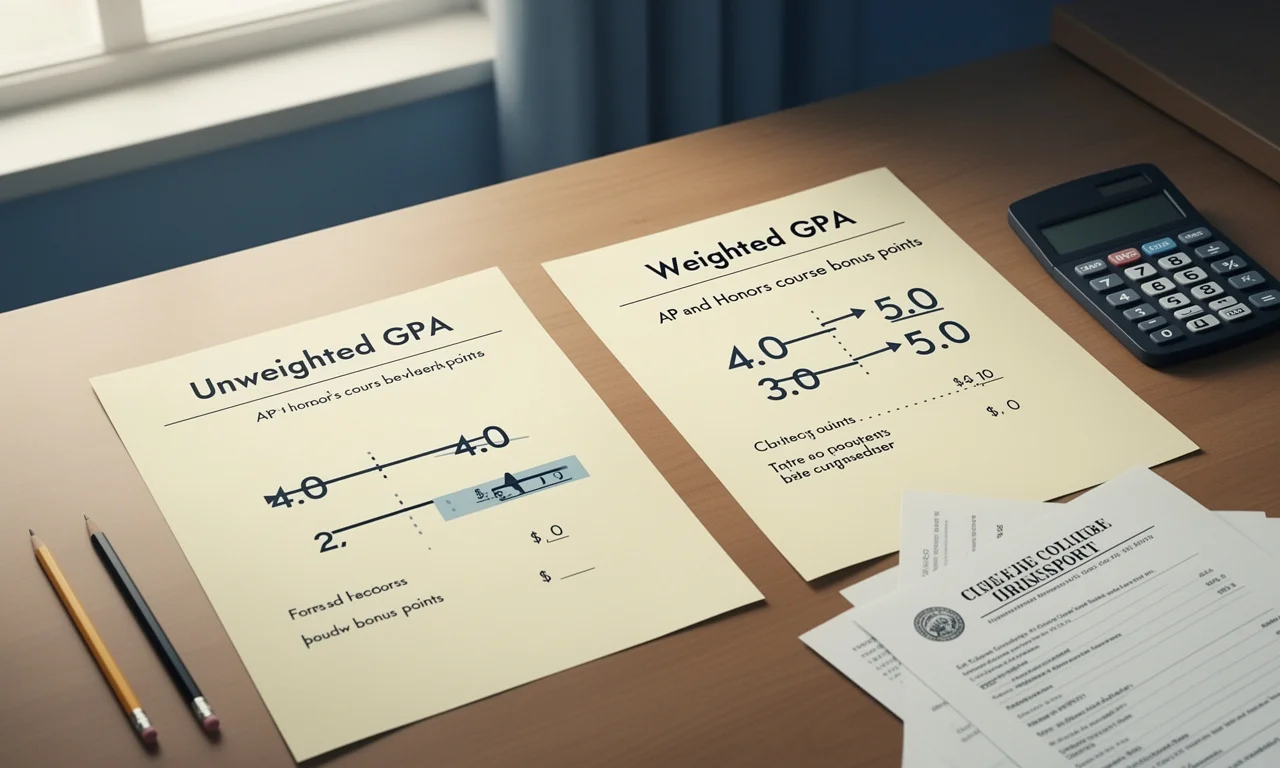
Weighted and unweighted Grade Point Average (GPA) measure the same raw grades using two different scales. Unweighted GPA assigns identical grade point values to every course regardless of difficulty level, producing a maximum of 4.0. Weighted GPA adds bonus points for Advanced Placement (AP), International Baccalaureate (IB), and Honors courses, allowing scores above 4.0. The formula for calculating both types is identical — the only difference is which grade point values each system assigns before the calculation runs.
What is the difference between weighted and unweighted GPA?
Unweighted GPA treats every course equally on a 4.0 scale. Weighted GPA adds 0.5 grade points for Honors courses and 1.0 grade point for AP or IB courses, raising the maximum possible score to 5.0 or higher depending on the school's policy.
The practical effect: a student earning a B in AP Chemistry receives a 3.0 on the unweighted scale and a 4.0 on the weighted scale. The grade is identical — only the scale changes. Two students with the same letter grades across different course levels will produce different weighted GPAs but identical unweighted GPAs.
Unweighted GPA answers the question: "What grades did the student earn?" Weighted GPA answers the question: "What grades did the student earn, and how difficult were those courses?"
How do you calculate unweighted GPA?
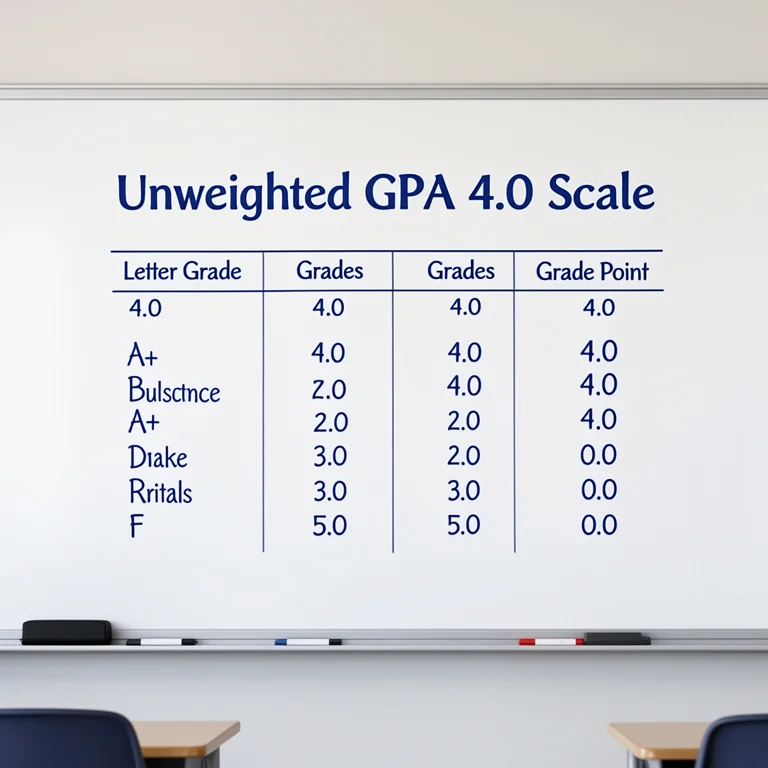
Multiply each course's grade point value by its credit hours to get quality points per course. Sum all quality points. Sum all credit hours. Divide total quality points by total credit hours. Unweighted GPA uses the standard 4.0 grade point table for every course without exception.
The grade point values on the standard 4.0 unweighted scale:
| Letter Grade | Percentage | Grade Point |
|---|---|---|
| A / A+ | 93–100% | 4.0 |
| A− | 90–92% | 3.7 |
| B+ | 87–89% | 3.3 |
| B | 83–86% | 3.0 |
| B− | 80–82% | 2.7 |
| C+ | 77–79% | 2.3 |
| C | 73–76% | 2.0 |
| C− | 70–72% | 1.7 |
| D+ | 67–69% | 1.3 |
| D | 65–66% | 1.0 |
| F | Below 65% | 0.0 |
Worked example — unweighted GPA for one semester:
| Course | Grade | Grade Point | Credits | Quality Points |
|---|---|---|---|---|
| English III (Standard) | A | 4.0 | 3 | 12.0 |
| AP Biology | B+ | 3.3 | 4 | 13.2 |
| Honors Algebra II | A− | 3.7 | 3 | 11.1 |
| World History (Standard) | B | 3.0 | 3 | 9.0 |
| Totals | 13 | 45.3 |
Unweighted GPA = 45.3 ÷ 13 = 3.48
Notice that AP Biology and Honors Algebra II receive no bonus treatment. The B+ in a college-level AP course contributes the same grade point value as a B+ in a standard elective.
How do you calculate weighted GPA?
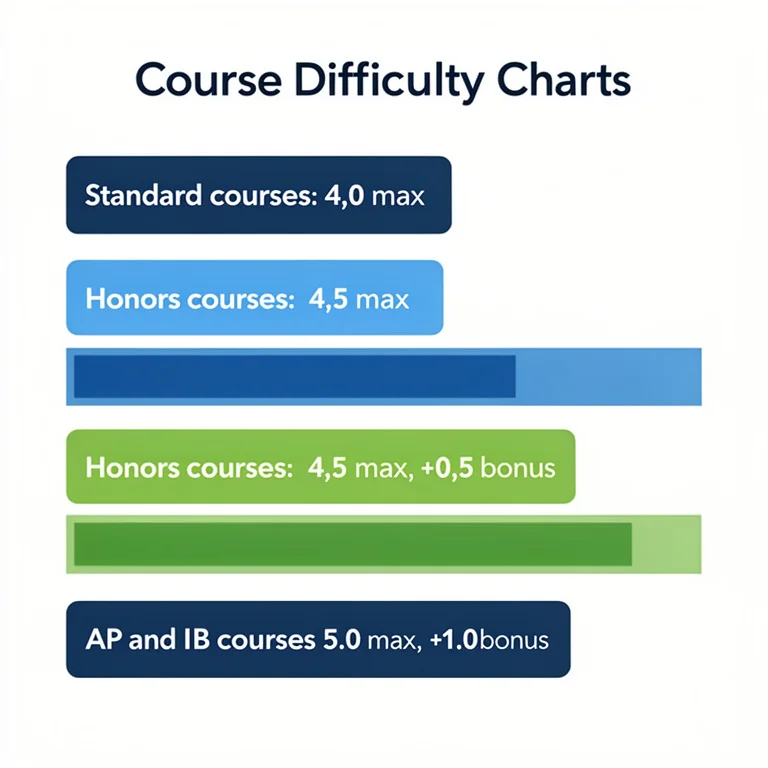
Apply the same credit-weighted formula used for unweighted GPA, but add 0.5 grade points to every Honors course grade and 1.0 grade point to every AP or IB course grade before multiplying by credit hours. The bonus applies to the grade point value, not to the final GPA.
The three-tier weighted bonus structure used by most US high schools:
| Course Level | Grade Point Bonus | Maximum Grade Point for an A |
|---|---|---|
| Standard | +0.0 | 4.0 |
| Honors | +0.5 | 4.5 |
| AP / IB / Dual Enrollment | +1.0 | 5.0 |
Worked example — weighted GPA for the same semester:
| Course | Grade | Bonus | Weighted Grade Point | Credits | Quality Points |
|---|---|---|---|---|---|
| English III (Standard) | A | +0.0 | 4.0 | 3 | 12.0 |
| AP Biology | B+ | +1.0 | 4.3 | 4 | 17.2 |
| Honors Algebra II | A− | +0.5 | 4.2 | 3 | 12.6 |
| World History (Standard) | B | +0.0 | 3.0 | 3 | 9.0 |
| Totals | 13 | 50.8 |
Weighted GPA = 50.8 ÷ 13 = 3.91
The same semester produces an unweighted GPA of 3.48 and a weighted GPA of 3.91 — a difference of 0.43 grade points from taking two advanced courses. A student carrying six AP and Honors courses per semester over four years can accumulate a weighted GPA above 4.5 while holding an unweighted GPA below 4.0.
What happens to weighted GPA when schools use different bonus scales?
Weighted GPA calculations vary by institution. Some schools add 0.5 for Honors and 1.0 for AP. Others add 1.0 for Honors and 2.0 for AP, producing maximum GPAs of 6.0. A few schools use a 4.5-point cap, limiting any course bonus to 0.5 regardless of level.
Three real-world bonus scales in active use across US high schools:
- Standard scale (most common): +0.5 Honors, +1.0 AP/IB. Maximum GPA for all A's in AP courses: 5.0. Used by the majority of public high school districts including most schools in Texas, Florida, and Illinois.
- Modified scale: +0.33 Honors, +0.67 AP. Maximum GPA approximately 4.67. Used by a minority of districts that prefer less inflation over the standard model.
- 10-point scale: Some high schools in North Carolina and Virginia operate on a 100-point percentage system converted to GPA, where weighted courses shift grade thresholds rather than adding bonus points to grade point values.
Because of this variation, two students with identical transcripts from different high schools may report different weighted GPAs. The University of California system and the University of Michigan both recalculate applicant GPAs using their own standardized scales to make comparisons fair across schools. Students applying to selective universities should calculate both a self-reported weighted GPA using their school's scale and an unweighted GPA, since many admissions offices standardize all submissions before comparison.
How does the same student's weighted and unweighted GPA compare side by side?
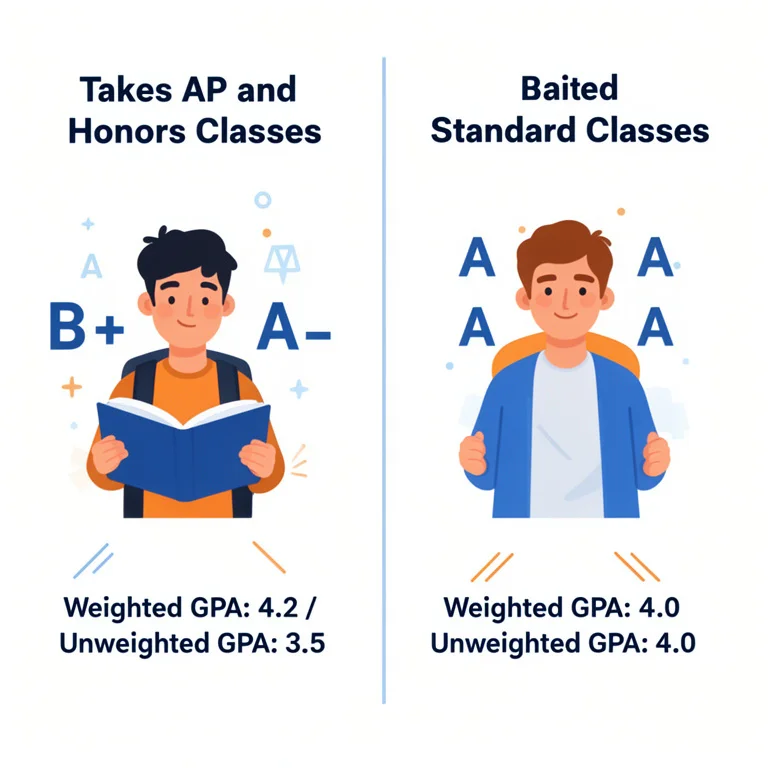
A student taking four AP courses and two standard courses per semester with a B+ average will earn an unweighted GPA near 3.3 and a weighted GPA near 4.3 — a full point of separation driven entirely by course level, not by grade performance.
The comparison below uses two students with different course selections but similar grade patterns:
| Student A (AP-heavy load) | Student B (Standard load) | |
|---|---|---|
| Courses | 4 AP, 2 Standard | 6 Standard |
| Grade Average | B+ across all courses | B+ across all courses |
| Unweighted GPA | 3.30 | 3.30 |
| Weighted GPA | 4.30 | 3.30 |
Student A and Student B earned the same letter grades. Unweighted GPA produces identical results for both. Weighted GPA reveals that Student A challenged a harder curriculum and earns a full grade point premium for it.
Selective colleges — including the University of California system, which reviewed more than 200,000 applications in 2024 — use recalculated unweighted GPAs as the primary comparison tool because weighted GPAs from different schools are not directly comparable. Course rigor analysis from the transcript itself supplements the GPA number.
Which GPA do colleges use — weighted or unweighted?
Most selective colleges recalculate GPA using their own standardized formula, which resembles the unweighted scale. Colleges review the transcript for course rigor separately from the GPA number, so weighted GPA alone does not guarantee a stronger application than a high unweighted GPA.
Three approaches colleges take when reviewing GPA:
- Direct transcript review: Colleges such as MIT, Princeton, and Yale evaluate course-by-course grades and difficulty without assigning a single GPA number a decisive role. The transcript shows all course levels, and the admissions committee reads rigor directly from the course list.
- Unweighted recalculation: The University of California system recalculates all applicant GPAs using a 10th-12th grade unweighted formula, awarding +1.0 for approved UC-weighted courses to a maximum of 8 semesters. This produces a UC-calculated weighted GPA separate from the school-reported figure.
- Self-reported weighted GPA: Many schools including state flagship universities accept the school-reported weighted GPA at face value and use the school profile document submitted by the counselor to interpret the number in context.
The practical takeaway: a 3.5 unweighted GPA from a rigorous AP-heavy schedule often outperforms a 3.9 unweighted GPA from an all-standard-course schedule at selective institutions, because course rigor is analyzed alongside the GPA figure. Students aiming for merit scholarships should check whether each target school awards scholarships based on weighted or unweighted GPA, as scholarship committees use different criteria from admissions committees.
How do weighted and unweighted GPA apply in college, not just high school?
College GPA is always unweighted. No US college or university adds difficulty bonuses for harder courses in GPA calculation. All college courses — introductory, major-level, graduate-level seminars — receive identical grade point values on the 4.0 scale.
Graduate programs, medical schools, law schools, and employers requesting GPA all use the unweighted college GPA. The American Medical College Application Service (AMCAS), which processes applications for over 140 US medical schools, calculates both a cumulative GPA and a science GPA (Biology, Chemistry, Physics, and Math courses only) — both on the standard unweighted 4.0 scale.
Students transitioning from a weighted high school GPA to a college GPA sometimes expect their strong weighted average to carry over. The unweighted college GPA resets the baseline. A student who earned a 4.5 weighted high school GPA begins college at 0.0 and builds from the first semester's grades using the standard 4.0 formula. The GPA calculator at gpacalculator.uk handles both high school and college GPA calculations and supports weighted input for high school course planning.
For a detailed breakdown of how unweighted college GPA accumulates across multiple semesters, the guide on how to calculate cumulative GPA across multiple semesters covers the credit-weighted formula in full. Students comparing their cumulative GPA to the semester GPA can also consult the cumulative GPA vs semester GPA explained article on this site.
Browse all GPA planning guides in the resources section at gpacalculator.uk/resources.
Frequently Asked Questions
What is the difference between weighted and unweighted GPA?
Can you have a weighted GPA above 4.0?
Do colleges look at weighted or unweighted GPA?
Is a 3.5 weighted GPA good?
How do you convert weighted GPA to unweighted GPA?
Written by
Adnan Ajmal
Software Developer
Adnan built GPA Calculator to give students a free, transparent tool for tracking their academic standing. All formulas follow the standard weighted average method used by US university registrars. Learn more about this site.
Related Articles

PhD Program GPA Requirements: What Admissions Committees Actually Look For
PhD admissions committees evaluate GPA through three lenses: trajectory (did grades improve over time?), subject alignment (were strong grades earned in relevant courses?), and institutional context (what does this GPA represent at this institution?). The minimum stated threshold is 3.0 at most programmes; the competitive threshold for admission at programmes of significant quality is 3.5 or above.

Academic Dismissal and GPA: Your Options for Readmission
Academic dismissal is the formal separation of a student from their institution after sustained failure to meet minimum GPA standards, typically a 2.0 cumulative average. Most institutions provide a structured readmission pathway through a formal appeal process, a required separation period of one academic year, and specific academic conditions attached to reinstatement.

Grade Forgiveness Policies: Which Colleges Offer Second Chances
Grade forgiveness policies, also called academic renewal, fresh start, or grade replacement depending on the institution, allow students to reduce or eliminate the GPA impact of previously earned failing grades. The original grades remain on the transcript in nearly all cases but are excluded from the cumulative GPA calculation. Graduate and professional school applications, including AMCAS and LSAC, typically include all attempted courses regardless of institutional forgiveness.

AP Exam Scores vs AP Class Grades: Which Matters More for GPA
AP class grades enter the high school weighted GPA calculation directly. AP exam scores do not. An A in AP Chemistry earns 5.0 weighted quality points regardless of what score the student earns in May. However, colleges use AP exam scores as an external benchmark to evaluate whether class grades reflect genuine mastery, and in the current test-optional environment, this evaluative role has grown.