What GPA Do You Need for a Full Ride Scholarship
Most full ride scholarships require a minimum GPA between 3.0 and 3.5, but competitive applicants typically hold 3.8 to 4.0. The exact threshold depends on whether the award is merit-based, need-based, athletic, or institutional.
Free GPA Calculator
Calculate your GPA instantly
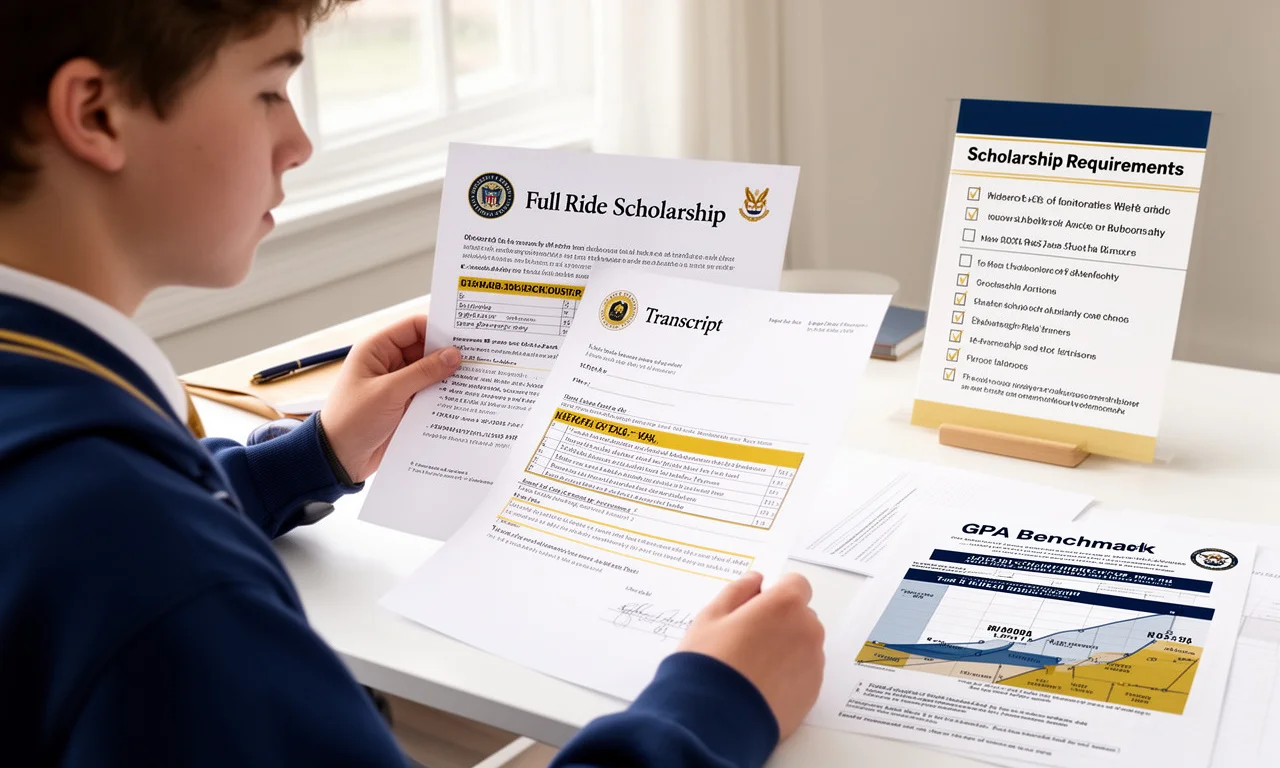
A full ride scholarship is a financial award that covers tuition, room and board, fees, and in some cases living expenses for the full duration of an undergraduate degree. Grade Point Average (GPA) requirements for full ride scholarships range from 2.5 for NCAA Division I athletic awards to 3.9 or higher for elite merit programs. The minimum GPA that qualifies a student depends on the scholarship type, the awarding institution, and whether the program evaluates weighted or unweighted GPA.
Most full ride scholarships set a minimum GPA between 3.0 and 3.5 on the 4.0 unweighted scale. Competitive applicants who receive merit-based full rides typically hold GPAs between 3.8 and 4.0 alongside a rigorous Advanced Placement (AP) or International Baccalaureate (IB) course load. GPA functions as an eligibility floor, not a selection guarantee — a student who meets the minimum still competes against applicants with stronger overall profiles.
GPA Requirements by Scholarship Type
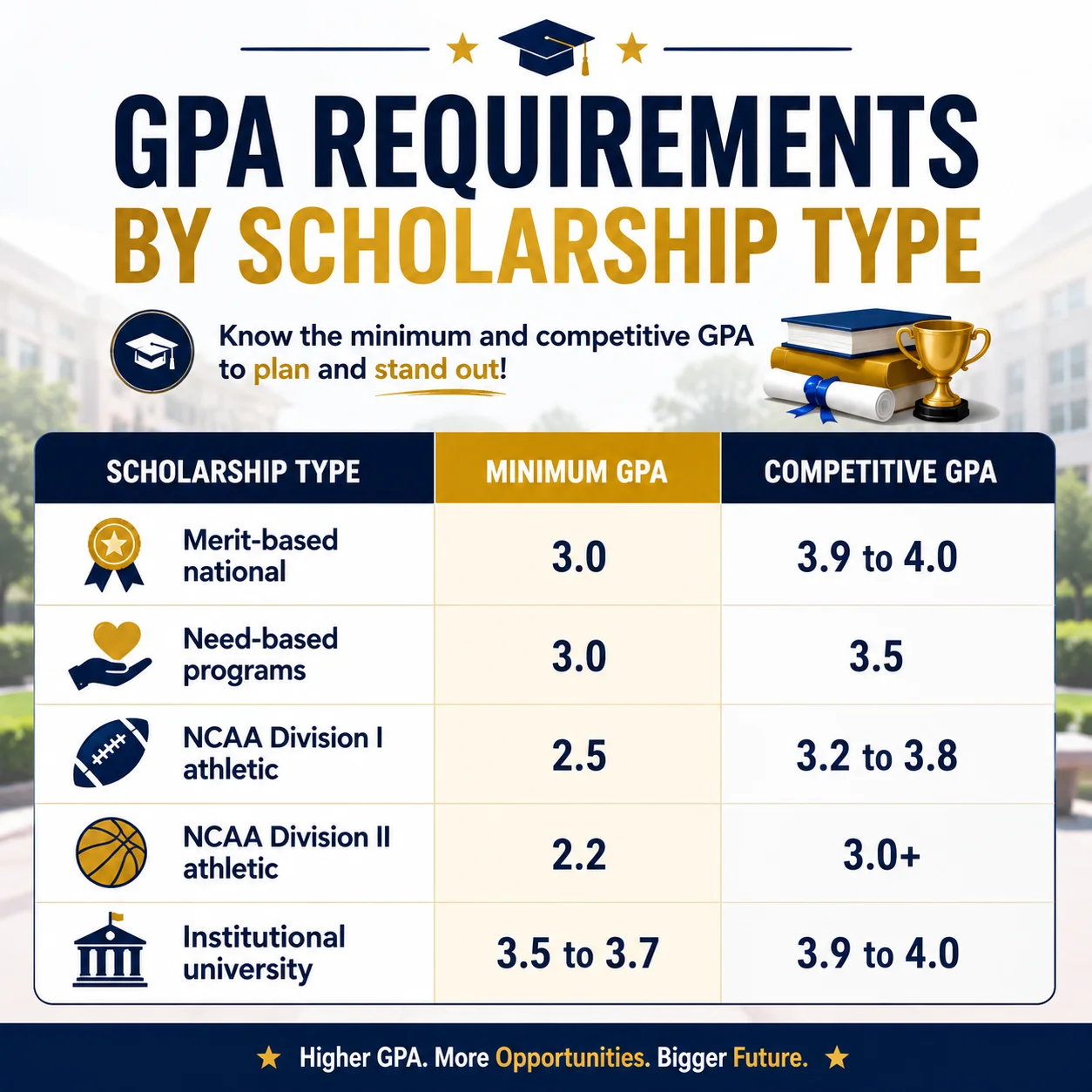
Full ride scholarship GPA requirements vary by award category: merit-based programs typically require 3.7 to 4.0, need-based programs require 3.0 or above, NCAA athletic scholarships require 2.5 for Division I, and institutional university awards typically require 3.5 to 4.0.
The table below shows documented minimum and competitive GPA ranges by award type:
| Scholarship Type | Minimum GPA | Competitive GPA |
|---|---|---|
| Merit-based national | 3.0 | 3.9 to 4.0 |
| Need-based programs | 3.0 | 3.5 |
| NCAA Division I athletic | 2.5 | 3.2 to 3.8 |
| NCAA Division II athletic | 2.2 | 3.0+ |
| Institutional university | 3.5 to 3.7 | 3.9 to 4.0 |
The minimum GPA secures eligibility. The competitive GPA describes the range where most recipients actually fall. Students at the minimum threshold compete against applicants near the top of the range, so meeting the floor alone is not sufficient for award selection a
 able-177558958.webp)
Merit-Based Full Ride Scholarship GPA Requirements
Merit-based full ride scholarships typically require a minimum unweighted GPA of 3.7 to 4.0. Programs including the Coca-Cola Scholars Program, Robertson Scholars Leadership Program, and university presidential scholarships select recipients who hold GPAs of 3.9 or above alongside national-level extracurricular records.
Named merit-based full ride programs and their documented GPA benchmarks:
- National Merit Scholarship: no stated GPA minimum; selection based on PSAT Selection Index and SAT score; typical finalists hold GPAs of 3.9 or above
- Coca-Cola Scholars Program: minimum GPA of 3.0 required; average recipient profile sits at 3.9 to 4.0
- QuestBridge National College Match: no formal GPA cutoff; program targets high-achieving students with demonstrated financial need; competitive applicants typically hold 3.7 or above
- Robertson Scholars Leadership Program (Duke and UNC): no stated minimum; recipients typically present 3.9 GPAs alongside significant community leadership records
- University of Alabama Presidential Scholarship: minimum unweighted GPA of 3.5 with a minimum ACT of 32 or SAT of 1470
Course rigor matters alongside the GPA number at every merit program. A student with a 3.9 GPA from a schedule of standard courses competes less favorably than one with a 3.7 GPA from a full AP course load, because scholarship reviewers evaluate the difficulty of the curriculum alongside the grade earned in it.
Need-Based Full Ride Scholarship GPA Requirements
Need-based full ride scholarships set lower GPA thresholds than merit-based awards, typically requiring a minimum of 3.0 on the 4.0 scale. Programs including the USDA 1890 National Scholars Program require 3.0 or above. The Posse Foundation Scholarship prioritises leadership potential alongside academic record.
Need-based programs use GPA as an eligibility floor rather than a primary selection criterion. Documented GPA requirements for three major need-based full ride programs:
- USDA 1890 National Scholars Program: cumulative GPA of 3.0 or higher on a 4.0 scale required at application
- Gates Scholarship: no formal GPA minimum stated; financial need and leadership evaluated holistically through a multi-round review
- Posse Foundation Scholarship: no GPA cutoff; leadership, teamwork, and academic potential assessed through a structured group interview and nomination process
Students from lower-income households with GPAs between 3.0 and 3.5 access need-based and hybrid programs more competitively than pure merit competitions, where the applicant pool concentrates above 3.8.
Athletic Full Ride Scholarship GPA Requirements
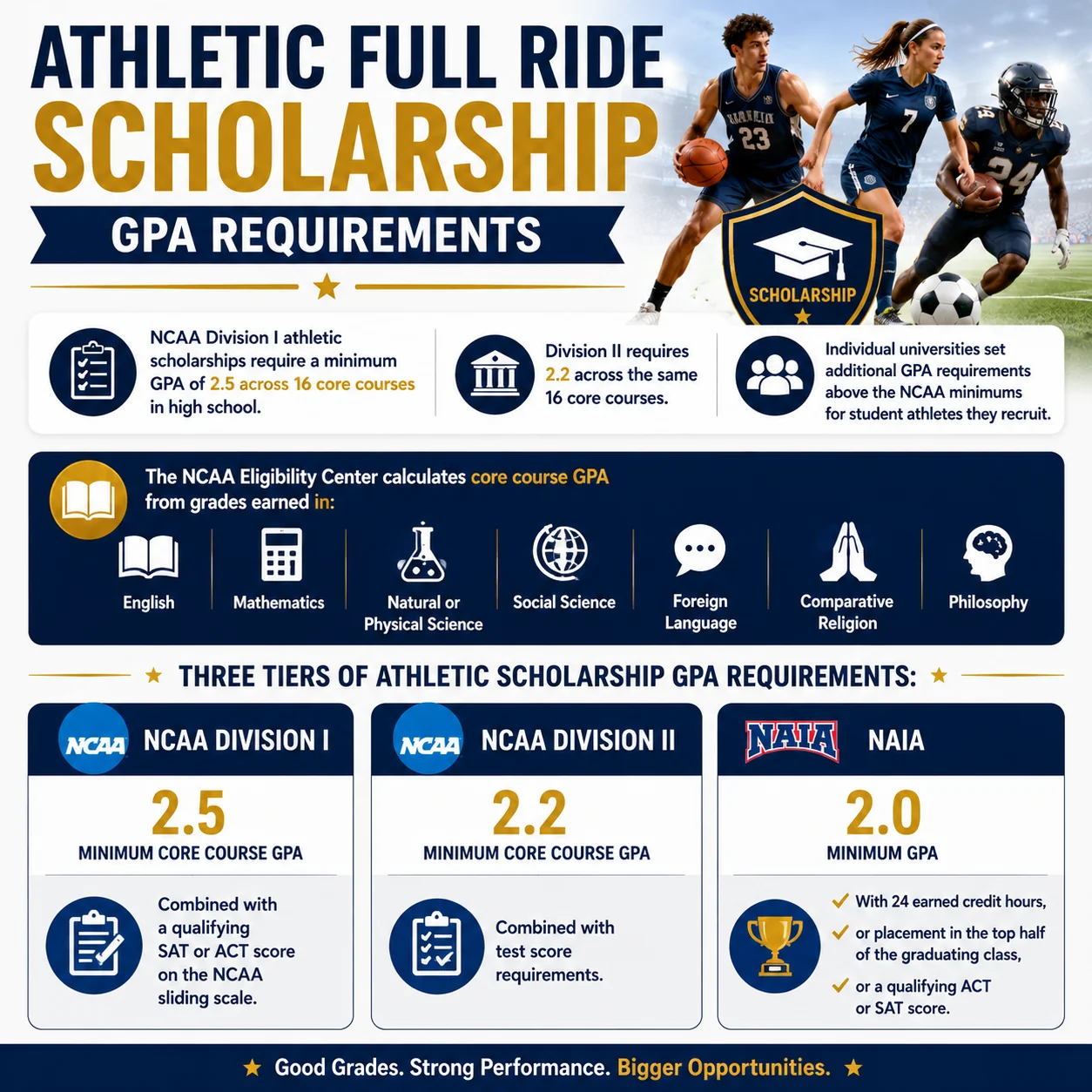
NCAA Division I athletic scholarships require a minimum GPA of 2.5 across 16 core courses in high school. Division II requires 2.2 across the same 16 core courses. Individual universities set additional GPA requirements above the NCAA minimums for student athletes they recruit.
The NCAA Eligibility Center calculates core course GPA from grades earned in English, mathematics, natural or physical science, social science, foreign language, comparative religion, and philosophy. Three tiers of athletic scholarship GPA requirements:
- NCAA Division I: minimum 2.5 core course GPA combined with a qualifying SAT or ACT score on the NCAA sliding scale
- NCAA Division II: minimum 2.2 core course GPA combined with test score requirements
- NAIA: minimum 2.0 GPA with 24 earned credit hours, or placement in the top half of the graduating class, or a qualifying ACT or SAT score
Student athletes competing for full ride scholarships at Power Five conference programs in football, basketball, baseball, softball, and tennis typically present GPAs well above the NCAA minimums. Coaches at selective programs report that full-scholarship recruits in academically demanding conferences carry GPAs between 3.2 and 3.8, since academic eligibility affects ongoing team standing and institutional reputation.
Institutional University Full Ride Scholarship GPA Requirements
Institutional full ride scholarships, awarded directly by colleges to incoming students, typically require a minimum unweighted GPA of 3.5 to 3.7 and a class rank in the top 5 to 10 percent of the graduating class. The University of Houston Tier One Scholarship average recipient held a 3.98 unweighted core GPA in fall 2024.
Four institutional scholarship benchmarks with documented GPA figures:
- University of Alabama Capstone Scholarship: minimum 3.5 unweighted GPA with a 30 ACT or equivalent
- Liberty University full-tuition scholarship: minimum 3.5 unweighted GPA with a 1350 SAT or 29 ACT and top-2 class rank verification from a school administrator
- University of Houston Tier One Scholarship: average 2024 recipient held a 3.98 unweighted core GPA and 34 ACT composite with class rank in the top 3 percent
- West Virginia University Honors Scholarship: minimum 3.75 unweighted GPA with a 29 ACT for full-tuition coverage
Institutional scholarship committees also receive the school profile submitted by the high school counselor, which documents the full range of courses available, the grading scale, and the school's academic context. A 3.7 GPA from a school offering 20 AP courses carries a different signal than a 3.7 from a school offering 4.
Does a Higher GPA Guarantee a Full Ride Scholarship?
A higher GPA does not guarantee a full ride scholarship. GPA functions as a qualifying threshold rather than a selection guarantee. Scholarship programs score applications on GPA, standardized test scores, leadership activities, community service, and personal essays simultaneously.
The National Merit Scholarship selects finalists based on the PSAT Selection Index, a writing sample, school endorsement, and SAT score — GPA does not appear as a formal scoring criterion in the selection process. A student with a 4.0 GPA and a weak personal statement competes against applicants with 3.8 GPAs and compelling narratives that directly address the scholarship's stated priorities.
Students planning toward full ride eligibility should calculate both their weighted and unweighted GPA accurately, since different programs specify different scales. The free GPA calculator at gpacalculator.uk computes both results by semester and shows how course grades affect the cumulative total.
How to Maintain GPA After Winning a Full Ride Scholarship
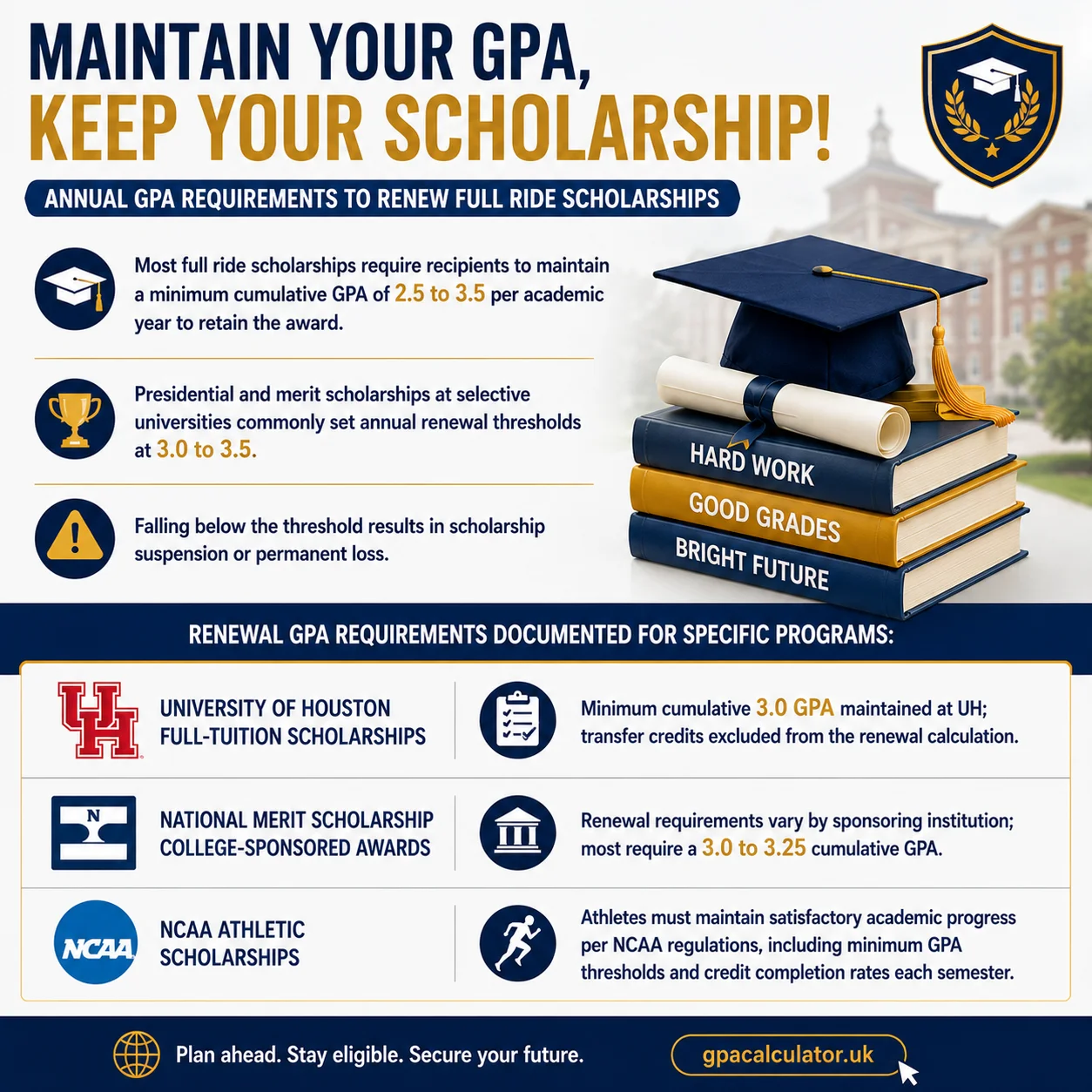
Most full ride scholarships require recipients to maintain a minimum cumulative GPA of 2.5 to 3.5 per academic year to retain the award. Presidential and merit scholarships at selective universities commonly set annual renewal thresholds at 3.0 to 3.5. Falling below the threshold results in scholarship suspension or permanent loss.
Renewal GPA requirements documented for specific programs:
- University of Houston full-tuition scholarships: minimum cumulative 3.0 GPA maintained at UH; transfer credits excluded from the renewal calculation
- National Merit Scholarship college-sponsored awards: renewal requirements vary by sponsoring institution; most require a 3.0 to 3.25 cumulative GPA
- NCAA athletic scholarships: athletes must maintain satisfactory academic progress per NCAA regulations, including minimum GPA thresholds and credit completion rates each semester
Students tracking their GPA semester by semester can use the free GPA calculator at gpacalculator.uk to project whether the cumulative average will meet renewal requirements after each term. For students working to raise a GPA toward scholarship eligibility thresholds, the guide on how many A's it takes to raise GPA by 0.1 provides the exact credit-weighted formula. Students comparing GPA vs class rank requirements for scholarship applications can review the GPA vs class rank admissions guide. All GPA planning resources are available in the resources section at gpacalculator.uk/resources.
Frequently Asked Questions
What GPA do you need for a full ride scholarship?
Can you get a full ride scholarship with a 3.5 GPA?
Do full ride scholarships look at weighted or unweighted GPA?
What GPA do you need to maintain a full ride scholarship?
Can a 3.8 GPA get a full ride scholarship?
Written by
Adnan Ajmal
Software Developer
Adnan built GPA Calculator to give students a free, transparent tool for tracking their academic standing. All formulas follow the standard weighted average method used by US university registrars. Learn more about this site.
Related Articles

PhD Program GPA Requirements: What Admissions Committees Actually Look For
PhD admissions committees evaluate GPA through three lenses: trajectory (did grades improve over time?), subject alignment (were strong grades earned in relevant courses?), and institutional context (what does this GPA represent at this institution?). The minimum stated threshold is 3.0 at most programmes; the competitive threshold for admission at programmes of significant quality is 3.5 or above.

Academic Dismissal and GPA: Your Options for Readmission
Academic dismissal is the formal separation of a student from their institution after sustained failure to meet minimum GPA standards, typically a 2.0 cumulative average. Most institutions provide a structured readmission pathway through a formal appeal process, a required separation period of one academic year, and specific academic conditions attached to reinstatement.

Grade Forgiveness Policies: Which Colleges Offer Second Chances
Grade forgiveness policies, also called academic renewal, fresh start, or grade replacement depending on the institution, allow students to reduce or eliminate the GPA impact of previously earned failing grades. The original grades remain on the transcript in nearly all cases but are excluded from the cumulative GPA calculation. Graduate and professional school applications, including AMCAS and LSAC, typically include all attempted courses regardless of institutional forgiveness.

AP Exam Scores vs AP Class Grades: Which Matters More for GPA
AP class grades enter the high school weighted GPA calculation directly. AP exam scores do not. An A in AP Chemistry earns 5.0 weighted quality points regardless of what score the student earns in May. However, colleges use AP exam scores as an external benchmark to evaluate whether class grades reflect genuine mastery, and in the current test-optional environment, this evaluative role has grown.